In the beginning
Prinses Julianalaan 92-96, Rotterdam
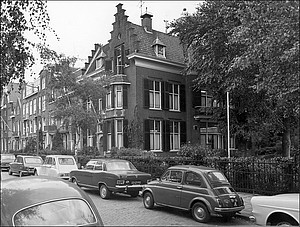
Rotterdam School of Management (RSM), Erasmus University, first opened its doors in 1970 in an elegant villa in the Rotterdam suburb of Kralingen. Its history, however, dates back to 1913, the year in which the Netherlands School of Commerce (Nederlandsche Handels-Hoogeschool, NHH) was founded through a private initiative with broad support from the Rotterdam business community. The Netherlands School of Commerce became the Netherlands School of Economics in 1939.
Almost 30 years later, in 1966, it commissioned an investigation into the feasibility of a Graduate School of Management, thus establishing a separate field of study dedicated to business administration. Two years later, Delft University of Technology joined the initiative.
IBB Building in Delft 1973-1984
A consensus on the lack of suitable post-experience training and higher educational facilities for managers in the Netherlands spurred Dutch-based multinationals to establish the Foundation for Business Administration, an institute for post-academic management education. The founding partners donated 4.5 million guilders (about 2.2 million euros) and included the following organisations (and their predecessors):
- Algemene Bank Nederland (ABN AMRO)
- Algemene Kunstzijde Unie (AkzoNobel)
- Amsterdam-Rotterdam Bank (ABN AMRO)
- Koninklijke Hoogovens en Staalfabrieken (TATA)
- Koninklijke Zout/Ketjen (AkzoNobel)
- Philips Gloeilampen Fabriek
- Shell
- Unilever
First Graduation ‘Drs in de Bedrijskunde’
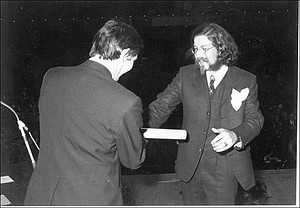
The result, inaugurated in 1969, was a new Graduate School of Management (Interfaculteit Bedrijfskunde) — a joint initiative of the schools of economics, law and social sciences of the Netherlands School of Economics, and of the schools of civil, mechanical and maritime engineering and general sciences at Delft University of Technology. The school became the first in the Netherlands to offer a business administration degree (Doctorandus in de Bedrijfskunde post-kandidaats) for students with a university qualification in a non-business discipline.
Classroom 1971
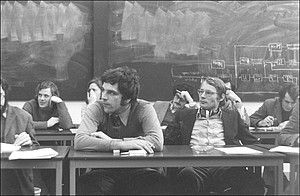
The school’s early beginnings were on a small scale. In 1970 the first class of 30 students – selected from hundreds of applicants – started their studies. From the very start, the school held a policy of international orientation. In 1972 it moved to Delft and was remodelled into the newly established Interuniversitaire Interfaculteit Bedrijfskunde/Graduate School of Management Delft of the Interuniversity Institute for Business Administration (Interuniversitair Instituut Bedrijfskunde, IIB). In November of the same year, the first cohort, or class, graduated with the new academic degree Doctorandus in de Bedrijfskunde (Drs.). The alumni association was formally established the same day: Vereniging van afgestudeerden van de Interfaculteit Bedrijfskunde (VIB).
Recent history
Woudestein campus building 1984
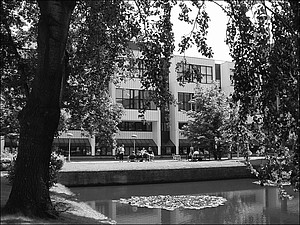
RSM’s more recent history in the 1980s and 1990s saw a decade of changes and expansion, and the development of the RSM that we might recognise today. After 12 years in Delft, the school moved to Rotterdam in 1984 and became part of Erasmus University. Because of a change in the Dutch higher education system, new degree programmes were started, first in 1984 with the four-year Doctorandus programme in Business Administration (Bedrijfswetenschappen), then in 1985 the International MBA Programme began, and in 1986 the PhD in Management Programme.
In 1989 the doctoral programme was established in addition to executive education programmes. In 1993, the ERASM research school was founded, bringing together researchers from the Faculty of Business Administration and the School of Economics. Known today as the Erasmus Research Institute of Management (ERIM), it has since become one of Europe’s leading management research facilities. In 1995 the Part-time Doctorandus in Business Administration (Bedrijfswetenschappen) was launched as well as the Executive MBA Programme, and in 1999, a further series of executive education programmes were initiated.
Internationalisation part 1
International relationships

Steps towards internationalisation were taken in 1975 when the curriculum was revised, and from 1977 onwards the focus turned towards internationalisation of the school. The first exchange programme was established with Wharton in 1977, and the number of English-language modules with an international focus expanded. In 1984, the four-year doctorandus programme was launched. The first European Global Alliance in Master’s Education (CEMS) master degree was conferred in 1991, as a result of RSM’s assimilation into the prestigious international CEMS network. In addition to being a member of the CEMS consortium with its MSc in International Management/CEMS programme, RSM was also a member of the OneMBA consortium (for the Global Executive OneMBA) until 2021 when it launched its own Global Executive MBA programme.
Other partners include the Partnership In International Management network (PIM), the European Foundation of Management Development (EFMD) network, Graduate Management Admission Council (GMAC) and the American Council on Education (ACE).
Internationalisation part 2
International recruitment
In 2003, the international bachelor programme (IBA) – an English-language bachelor programme with a recruitment target of 50 per cent of students from outside the Netherlands – was established. From 2006, all master programmes have been taught in English.
In keeping with its highly international approach, RSM actively recruits students from all over the world for all of its programmes, and maintains relationships with academic partners; these are renowned research universities and business schools with which RSM has established dual degree programmes and exchange relationships.
In the recent past, RSM had offices in Chengdu, China; Taipei, Taiwan; and in Amsterdam in the Netherlands, in order to offer local populations services like guidance and information about BSc, MSc and MBA programmes, alumni networking, and contacts. RSM has a website in Chinese at www.rsmerasmus.com.
Accreditation
RSM was among the first European schools to receive Association to Advance Collegiate Schools of Business (AACSB) accreditation in 1998. What’s more, RSM is among the 1 per cent (74) of schools worldwide with triple crown accreditation, meaning it also has the Association of MBA’s (AMBA) in 1996 and EQUIS (European Quality Improvement System) European Quality Improvement System (EQUIS) in 1998, accreditations. Triple accreditation is an indicator of exclusive quality and highlights RSM’s international reputation.
RSM has also been accredited by the Netherlands Academy of Arts and Science (KNAW) since 1999, and by the Dutch-Flemish Accreditation Organisation (NVAO) since 2007.
RSM today
From its humble beginnings, RSM has grown into one of Europe’s most successful and internationally-recognised business schools, as reflected in the research and programme rankings of national and international media.
Over the years RSM has added to its portfolio of programmes to reflect changes and trends in business.
It now offers two bachelor programmes, and 19 pre-and post-experience master programmes. RSM also offers four MBA programmes including the Cologne-Rotterdam Executive MBA launched in 2016, the Executive MBA programme for experienced and globally-oriented professional launched in 1995, and the world’s first truly global MBA programme in partnership with four top business schools located in four continents, the Global Executive OneMBA, launched in 2002.
RSM also offers a range of executive education programmes as well as a part-time PhD and full-time PhD programmes.