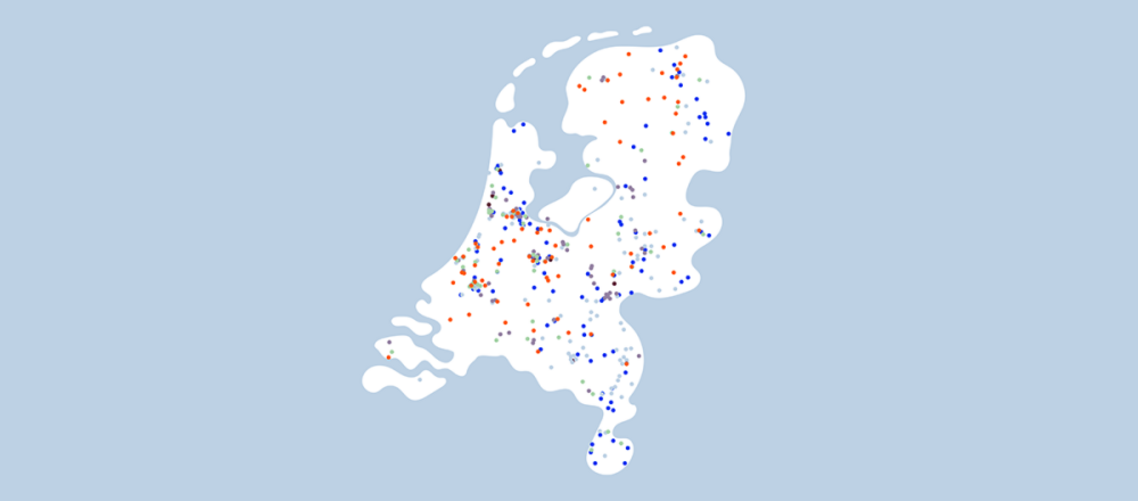
Citizen collectives offer alternative solutions to many of the major societal challenges and issues faced by the Netherlands. They play an expanding role in areas such as the energy transition, innovations in health and social care, community led housing, local food chains and community democracy. The Citizen Collectives Monitor 2025 (Burgercollectieven-monitor) provides evidence-based insights that help to support them by showing how they work, where they are they active, how they function and what opportunities and obstacles they experience.
Useful information for policymakers
The results are relevant for policymakers, umbrella organisations, civil society institutions and citizens who want to understand how collective action is developing and what support is needed to strengthen the resilience of the movement. The monitor gives a broad and in-depth overview of the current state of local self-organisation in the Netherlands, and includes a detailed analysis of initiatives in sectors like energy, housing, health and social care, and nature, food and agriculture.
Citizen collectives operate between market and state. They are neither, but instead form a third logic based on solidarity, self-organisation and local roots. The monitor shows that cooperation with government is desired but often difficult for precisely this reason, as these different logics can clash.
Internal and external challenges
The monitor shows that initiatives face structural challenges. Financial issues are the most common and many initiatives struggle with external funding and financial independence. Internal organisation also requires attention; a quarter of all collectives find decision making and democratic participation complex.
And many collectives find retaining active members and volunteers difficult, even though the initiatives themselves contribute to broad societal wellbeing and community cohesion; participation is still socially selective. Energy initiatives, for example, tend to attract higher income groups, while health and social care initiatives reach more people with lower incomes.
Sectors, size and organisational forms
The 431 participating collectives studied by the researchers are mainly active in health and social care (27.6 per cent), energy (17.9 per cent), housing (15.5 per cent), and food, nature and agriculture (11.4 per cent). Common legal forms are foundations (36 per cent), cooperatives (27 per cent) and associations (26 per cent). A large share of the collectives has a substantial membership base: 48 per cent have more than 200 members. Energy and health care collectives in particular tend to have large groups of participants.
Professionalisation continues
The monitor shows that local initiatives are increasingly developing into structural societal actors. Many initiatives join umbrella networks, use proven organisational models – for example the Dutch community farming model Herenboeren – and combine different activities to have broader local impact and improve their resilience.
Institutional foundations remain fragile
Despite this growth, the legal and governance structures of many initiatives remain vulnerable. There is a clear need for more knowledge sharing, legal advice and support to help build durable organisational structures. Policymakers, funders and intermediary organisations can play an important role here.
Read the first Citizen Collectives Monitor (Burgercollectieven-monitor 2025)
Find out more about the CollectieveKracht