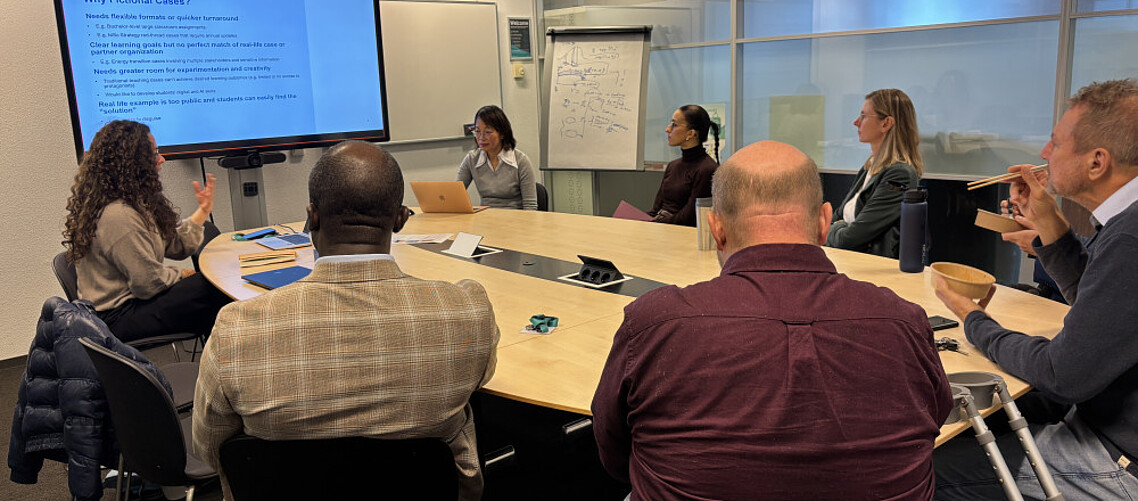
Why fictionalize a case?
Solange and Tao explained that fictionalization can be a valuable alternative for creating business cases when access to data is limited, topics are sensitive, or there are frequent course updates that require new materials. Fictional cases can also be tailored to specific learning goals and designed more efficiently. Educators can consider it as ‘reverse engineering’ content according to the desired teaching outcomes. Fictionalization also helps when real companies prefer to remain anonymous or when instructors want to prevent students from finding real-world solutions online. In these ways, fictional cases allow for authentic, creative, and flexible experiential learning opportunities.
Using generative AI in case development
Every year, a new cohort of students is asked to act as external consultants to solve a corporate partner’s real-world problems in the RSM Strategy Case Project course in the MSc in Strategic Management. But using real company challenges is sometimes a headache because course coordinators have insufficient data or an ambiguous scope for the project, making it difficult to source a new partner company each time.
Or they could use a historical case for this six-week assignment, which would give students a satisfying conclusion when the actual decision and outcome are revealed.
A handy third option is to create a work of fiction. This is how the FixRight Solutions case came about. It was inspired by an electronics repair firm, chosen for its clear decision-making potential and relatability for students. Case writers used generative AI to anonymize sensitive details, synthesize realistic survey results and quotes, and generate data sets that aligned with the depth and breadth of the course’s learning objectives. It allowed the CDC to complete a high quality first draft in under a week, and was easy to replicate for future cases. The FixRight Solutions case is available on request.
Fictionalizing to teach real-world complexity
Earlier in 2025, the CDC collaborated with the Erasmus Centre for Energy Transition to embark on helping non-technical business and law students to understand the issues of multifaceted energy transition faced by public and private institutions. Companies approached by the CDC team were reluctant to be profiled out of concern that any case study focused on them might quickly become outdated in this rapidly changing industry. So they turned to fictionalization to create realistic and contextually rich teaching cases, one of which is Stuck in Gridlock.
The trigger for this case was a real policy debate in the Netherlands about limiting the hours for EV charging. The information in this debate plus RSM’s rigorous faculty research resulted in a multi-stakeholder role-play in which students represent different actors, from municipal officials to grid operators. In the role-play, the students must negotiate feasible solutions for a grid that is bursting at the seams.
The beauty of fictionalizing this case lies in the ability to craft a multitude of perspectives involved in the grid congestion issue, including those that may otherwise remain unexamined or unavailable. It enables students to explore trade-offs and systems thinking in a dynamic and relatable context. This case has been tested in RSM’s master and executive education programmes, and has proved effective in allowing students to experience the complexity of energy transition challenges first-hand – a mainstay of research-driven, practice-oriented education at RSM.
An experimental chatbot interview
The CDC team demonstrated an experimental case, Repricom, featuring an interview simulation facilitated by an AI chatbot. Students ask the chatbot to answer targeted questions to uncover information and identify the root cause of a business challenge. The chatbot’s responses adapt to the tone and quality of the students’ questions so they are prompted to think critically and create more precise questions while maintaining a respectful approach. This case provides an engaging, inquiry-based learning experience. The Repricom case is available on request.
The chatbot required repeated prompting, testing and refinement to achieve its human-like characteristics and to define the scope of its knowledge so that it was effective for learning. This AI-facilitated interview simulation was developed and tested on the Experiment with EduGenAI platform. It lowers the barrier for instructors who may not feel comfortable conducting live roleplay sessions while preserving the realism of interactive learning.
Get involved
The CDC offers comprehensive support to researchers interested in transforming their work into impactful learning materials. If you have an interesting research project and are looking for ways to maximize its impact through a teaching case, contact the CDC. Our experienced case writers can support brainstorming sessions and guide you through the development process. With over 15 years of expertise in case development, the CDC can help adapt your research for educational use, provide professional writing assistance, and facilitate publishing and promotion to increase its reach and impact.
Getting the CDC involved early in your research process can strengthen funding applications and ensure an efficient case development process.
This seminar was one of our quarterly Brown Bag Seminars on Creating Memorable Cases. Join the RSM Case Community to stay updated on future seminars via cdc@rsm.nl