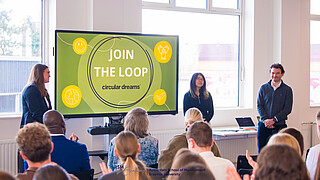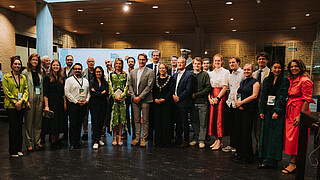
Alumna Rachel van der Pol, a Programme Director at Dutch NGO Orange Corners, graduated from RSM in 2018. Since then she has had several roles working on projects promoting innovation and development in Africa. She was talking with Dr Taslim Alade, Senior Lecturer at RSM and coordinator of a minor elective study course on African Dynamics that’s offered to students at three collaborating Dutch universities: Leiden University, Delft Technical University, and Erasmus University Rotterdam. The three universities collaborate in specific subject areas in a strategic alliance known as LDE.
“I love how a brief interaction with Taslim turned into such a meaningful collaboration between RSM and Orange Corners,” said Rachel. Orange Corners is a Dutch NGO supporting young entrepreneurs in Africa, Asia and the Middle East to build sustainable, profitable businesses that contribute to a more inclusive and prosperous society. “This collaboration came about quite organically when my path crossed with Taslim’s and we both saw a great opportunity to connect our worlds to bring positive impact across Africa.”
She said she was genuinely impressed how the students managed to translate theoretical frameworks into concrete actionable ideas for impact in such a short time.
The African Dynamics minor elective is a collaboration that builds on the goals set in the African Union Agenda 2063 and the United Nations Agenda 2030. It’s an opportunity for bachelor students to work in interdisciplinary teams to solve the challenges and leverage the potentials available to young African entrepreneurs.
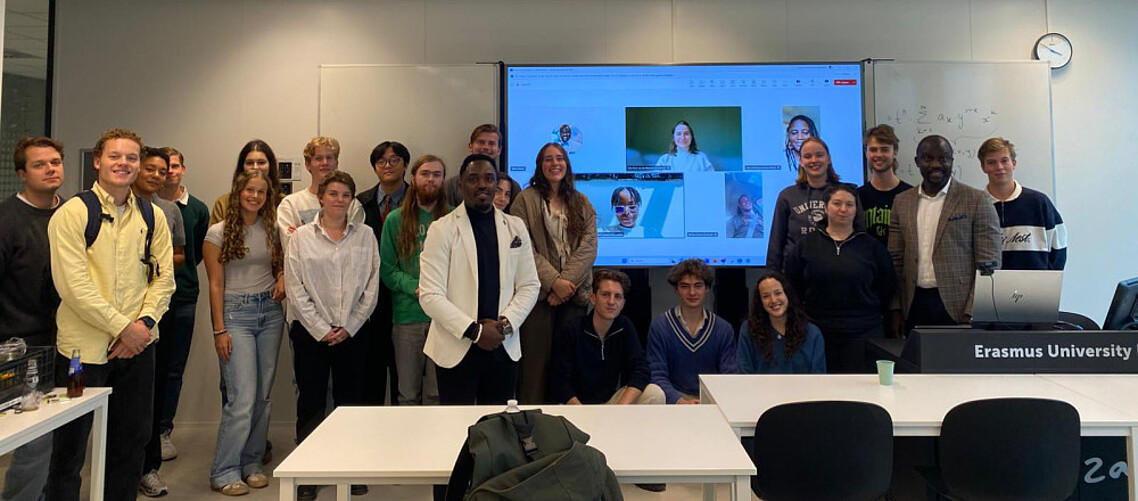
In the autumn of 2025, and with great enthusiasm, 27 bachelor students from the three universities worked to create sustainable solutions with four entrepreneurs from African nations and their real challenges. Over four weeks, the students, working in interdisciplinary teams, applied their theoretical knowledge to real challenges to develop innovative and practical strategies for creating innovative cross-border solutions for business and society. They communicated with the African entrepreneurs in a series of online consultations and meetings, and the project culminated in a final impact event held at RSM with the entrepreneurs joining in online, on 10 October. Their impact was undeniable.
Compact, creative and consequential learning
“Working with the LDE students gave us great value and insight towards our future engagements, to further strengthen our focus on creating inclusive, sustainable, and transparent supply chains that strengthen livelihoods and regional food security in the agricultural sector of East Africa,” said Recab Mwesigwe who represented Ndarogyi Enterprises from Uganda.
Chidimma Uzoma of Zayith Food company from Nigeria had two favourite ideas from the project: refill stations and biofuel conversion, and said the students’ engagement and depth of research were impressive. Vuyiseka Geza of Geza Smart Living from South Africa valued the e-waste recycling strategy that represents the intersection of the social-ecological angle of the sustainability triangle’s social, environmental and economic considerations. Abigail Ogunyemi of Mellowpads from Nigeria added that the students’ depth of research and creativity sparked thoughts such as integrating digital health tracking tools in the company’s product ecosystem, and new paths for engagement and impact toward solving challenges to menstrual health.
The students share their views of what they gained from the African Dynamics minor, available in their podcast webpage from January 2026.
RSM student Armel Le Masne de Chermont (BSc International Business Administration 2026) said: “The LDE collaboration with African entrepreneurs really widened my eyes. Even though I am of a different background and culture, I found out that my input was still valuable in this very different continent; the collaboration also helped me understand how in the eyes of business and sustainability we truly are all interconnected and dependent on each other on a global scale.”
The overall excitement and engagement of students, entrepreneurs, lecturers and organisers was palpable during the event, says Dr Taslim Alade, who describes the results as “compact, creative, and consequential: students translated theory into concrete, actionable ideas for impact, and entrepreneurs left energised and ready to follow up.” And Rachel van der Pol wraps it up: “Partnering with the LDE African Dynamics course offered a unique change for mutual learning. I was genuinely impressed by how the student teams managed to translate theoretical frameworks into concrete, actionable ideas for impact.”