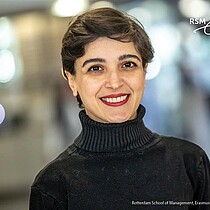
Niloofar Barzegar
Nationality: Iranian
Last job title: Medical doctor, anaesthesiologist
Previous degree: MD, Tehran University of Medical Science
1. Why did you choose to go back to school for an MBA? And why RSM?
“After working as a medical doctor and anaesthesiologist for about 10 years, including the intense time during the Covid-19 pandemic, I realised that many of the challenges I faced in the hospital were rooted not in clinical limitations, but in systemic ones. I wanted to contribute to healthcare in a broader, more strategic way; improving processes, addressing inefficiencies, and supporting more sustainable and resilient health systems. To do that, I needed to deepen my understanding of management, leadership, and the business side of healthcare. An MBA became the natural next step.
I chose RSM because of its strong international reputation, its focus on sustainability and responsible leadership, and its diverse community. RSM’s global environment felt like the right place to prepare for an international career in the healthcare industry. And studying in the Netherlands allowed me to continue learning in English, without the barrier of needing to learn another new language.”
2. How is the International Full-time MBA preparing you to do business in an uncertain world?
“It has prepared me to navigate an uncertain and rapidly changing world by exposing me to diverse perspectives, real-world challenges, and collaborative problem solving. Working in highly international teams pushed me to think beyond my clinical mindset and approach problems with a more open, strategic, and innovative lens.
One of the most impactful experiences was working on real business cases, such as the Living Management Project (LMP), which required applying theory to a real, client-facing complex challenge. This hands on exposure not only sharpened my analytical skills but also helped me understand how business decisions are made under uncertainty.
Building a professional network in a field where I previously had no experience has also been invaluable. Together, these experiences have strengthened my adaptability, broadened my business perspective, and equipped me with the confidence to operate effectively in unpredictable environments.”
3. How would you describe your RSM FTMBA experience so far?
“It has been both incredibly interesting and deeply challenging – in the best possible way. I was used to fast protocol-based decision making and a very structured environment. The MBA pushed me to shift that mindset into a more strategic, analytical, and collaborative approach. This transition has been eye opening and transformative.
I have found the culture at RSM to be supportive, international, and highly dynamic. Working closely with classmates from diverse nationalities and professional backgrounds helped me learn how to approach problems from multiple angles. Our discussions in class and group assignments often challenged me intellectually while also encouraging me to grow personally. I became more comfortable expressing my ideas, listening actively, and co creating solutions – even in areas where I had no prior experience.
This journey has also been incredibly rewarding. When I look back at my progress and the knowledge I’ve gained – from finance and strategy to leadership and innovation – I feel proud of how far I’ve come. It feels like I’m looking at a different version of myself: more confident, more adaptable, and better prepared for a career in the healthcare industry.
Overall, the RSM MBA has been a transformative and empowering chapter of my life, and I am truly grateful for the opportunity.”
4. What has been the biggest adjustment for you, while living in Rotterdam or the Netherlands?
“The biggest adjustment for me has definitely been the weather. Coming from the Middle East, I deeply miss the warmth and sunlight. Rotterdam’s windy and cloudy days were a real shock at first. Another challenge has been the housing situation. I was fortunate to stay in Xior initially, but now that I’m searching for a new place, I feel the pressure of the competitive housing market.”
5. What has been the most challenging assignment or course during the FTMBA so far? How did it challenge you?
“Corporate Finance has been the most challenging course for me so far. I had no prior exposure to financial concepts, so the learning curve felt steep from the very beginning. The course was intense, with frequent assignments that required careful calculations, detailed analysis, and a solid understanding of frameworks I had never used before.
What made the experience manageable – and ultimately rewarding – was the support within my team. One of my teammates had a finance background, and she generously guided us through each assignment, explaining concepts step by step. Working with her not only helped me complete the course but also gave me a strong foundation in finance that I never expected to gain. It was a true reminder of the value of teamwork and the power of learning from others.”
6. In what way has the Personal Leadership Development (PLD) component of the programme affected you?
“PLD challenged me to reflect on and revise my approach, helping me see leadership from a broader, more strategic perspective. One key development has been my comfort in delegating tasks and building trust within my teams, rather than striving to control every detail. This shift has strengthened team cohesion and improved efficiency.
PLD also expanded my communication skills. As an introvert, initiating networking conversations had always felt intimidating. Through PLD exercises with my group, I practiced starting conversations, giving and receiving feedback, and engaging more openly. These experiences have made me feel more confident and proactive in professional interactions.
The most eye-opening insight for me was realising how my perfectionism had created immense pressure to avoid errors at all costs. I learned that failure in a business context is not fatal but a natural and valuable part of learning. Embracing this mindset allows me to relax, enjoy the process, and grow as a more resilient leader.”
7. How are you planning to contribute to the Sustainable Development Goals through business?
“For my project in ‘The Craft of Managing for Positive Change’ I focused on creating a more sustainable healthcare system by providing mental health support for healthcare workers. The Covid-19 pandemic highlighted how critical mental and emotional well-being is, not only for individuals but also for the efficiency and resilience of healthcare systems. I strongly believe that sustainable healthcare requires healthy people, both mentally and physically. Yet mental and emotional support is often undervalued in high-pressure, fast-paced environments. By advocating for, and implementing, programmes that support healthcare workers’ well-being, I aim to contribute directly to the Sustainable Development Goals related to health and well-being.”
8. How have you utilised the alumni network so far?
“Connecting with alumni who share a similar background provided important guidance and mentorship – their advice helped me navigate assignments more efficiently, understand best practices for building a professional network, and gain insights into potential career paths. Most recently, their guidance on job searching and funding opportunities has been particularly helpful as I plan my next steps.
By learning from their experiences and applying their insights, I have been able to make more informed decisions and enhance my growth both academically and professionally.”
9. How has the Career Development Team helped you on your journey?
“The Career Development Team at RSM has been an invaluable support throughout my MBA journey. They are professional, warm, and highly knowledgeable. Beyond their professionalism, they create a supportive and friendly environment, offering personal guidance during challenging times and ensuring that every step of the career development process is clear and manageable.
The workshops and networking events they organise provide excellent opportunities to connect with industry professionals and learn from their experiences. In particular, the self-marketing classes were exceptionally impactful, teaching practical skills that have enhanced my personal branding and professional presence.”
10. What advice could you give to people who are considering doing an MBA?
“Pursuing a full-time MBA is a significant challenge, but it is entirely worth stepping out of your comfort zone. Looking back on this year, I am amazed at how much I have grown personally, professionally, and intellectually. An MBA is not just about classroom learning; for me, it has been a living experience.
My advice to prospective students is to embrace the challenge fully. Be open to learning from every interaction, every assignment, and every setback. Prepare to push your limits, explore new perspectives, and build lasting relationships. Don’t doubt yourself – take the step, and be ready for both the challenge and the joy that an MBA journey brings.”
11. Has your MBA journey changed your outlook on what your career might look like after you graduate? If so, how?
“The MBA has been a total game-changer for me, giving me the confidence and skills to transition from clinical medicine to the medical industry. It broadened my perspective on healthcare, exposed me to business strategy, and helped me envision a career where I can combine my medical expertise with strategic impact to improve healthcare systems and patient outcomes.”
12. What does the future hold for you?
“I see my future as a journey of continuous growth, pursuing a meaningful and impactful career in medicine. I want to combine my clinical experience with business insight to make real improvements in healthcare. My passion is creating positive change that benefits both patients and the systems that care for them.”