The Dies Natalis had the theme 'Curiosity connects, knowledge changes'. Moderator Simone van Trier introduced the Dies Natalis ceremony by summarising EUR’s role as a university that seeks to be connected to everyone in Rotterdam. A cautiously optimistic Chair of the Executive Board, Annelien Bredenoord explained that the new Strategy 2030 of Erasmus University aims to demonstrate its social licence to operate internationally, particularly against the backdrop of government cuts to higher education. She said Patrick Bolton’s research and way of operating echoes the EUR-wide strategy for 2030 in looking for ways to build bridges between fundamental research and societal applications. His contributions have continued to shape the practical world of finance, from corporate decision-making to regulatory frameworks.
Rector Magnificus Jantine Schuit had a hopeful message when she spoke of the connecting power of curiosity: when people learn from each other, the effect leads to more multidisciplinary work and innovative research projects. This dialogue makes an engaged university that contributes meaningfully as people and as citizens. A video from Eric van ’t Zelfde of EUR’s Social Advisory Council advocated for letting the voices of the vulnerable be heard as part of the sustainable and growing collaboration between the university and the city.
Awards at the Dies Natalis
Professor Patrick Bolton’s honorary doctorate was among the awards presented during the EUR Dies Natalis ceremony by RSM and Erasmus School of Economics (ECE) for his pioneering work and influential research on contract theory, climate finance, and corporate responsibility. He argues that companies should complement public policy, not replace it, and that firms have a societal responsibility beyond contracts. His research bridges academia and policymaking, with major global impact.
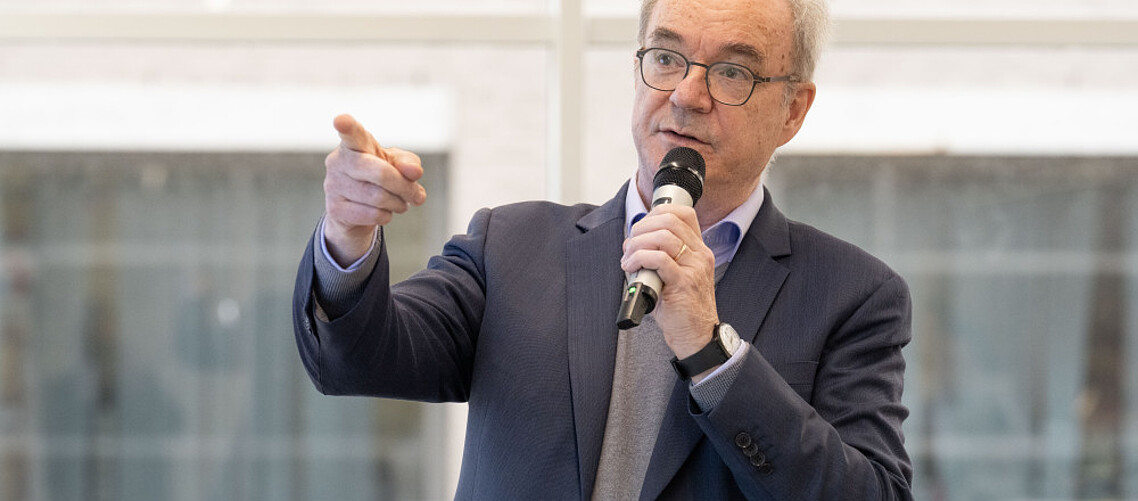
The laudatio for Prof. Bolton was given by Prof. Dirk Schoenmaker, professor of Banking and Finance at RSM, and an academic member of the Erasmus Platform for Sustainable Value Creation. In his speech, Prof. Bolton argued that corporate responsibility should be part of economic thinking, and that firms must act as responsible members of society. He urged students to follow their curiosity, ask naïve questions, and pursue their passions.
Erasmus professorship
Vincent Jaddoe, paediatrician and professor of paediatrics and epidemiology at Erasmus MC, was appointed fifth Erasmus Professor during the Dies Natalies Ceremony. He is the lead researcher for a large-scale study at Erasmus MC, Generation R, in which more than 20 departments from Erasmus MC and EUR work closely together to improve the health, well-being, and social participation of future generations.
The Lambers Student Excellence Award for exceptional achievement was presented to PhD candidate Dr Linda Al-Hassany, who has a broad vision on equality and inclusion in healthcare. She received a prize of €4,000 from the Erasmus Trust Fund.
The Erasmus Research Prize 2025 and a prize of €7,000 went to Dr Vivian Visser for her research into the willingness of citizens to participate in social and civic initiatives and how citizens see their own position in relation to the government. She includes research into subtle forms of exclusion, with a focus on language.
The FAME Athena Award 2025 went to the university’s chief diversity officer Prof. Wendy Harcourt for co-ordinating, creating and holding space for other women in the university, particularly students, PhD candidates and early career researchers.
Dialogue on sustainable finance
The following day, on 11 November, RSM celebrated Prof. Bolton’s honorary doctorate with a one-day conference on sustainable finance. Professors Patrick Bolton, Dirk Schoenmaker, Adair Morse (UC Berkeley), and Lissy Smit (Global Head Sustainability at Rabobank Wholesale and Rural) explored the vital responsibilities of businesses and financial institutions in tackling the climate crisis and how to advance the transition to a climate-neutral economy.
Dean of RSM Prof. Aukje Hassoldt underscored the importance of the event in her welcome and noted Prof. Patrick Bolton’s contribution to climate finance.
Things are different now
Patrick Bolton set the scene by looking back over the last 10 years since the Paris Agreement, considering the role of sustainable investments in corporate responsibilities, and the role of businesses and financial institutions in the route to climate neutral. His reflections on the future of climate finance and corporate responsibility now had a very different tone to his thoughts back then, he said.
Beginning with the good news, he noted the rise of clean renewable energy. But the bad news is that global CO2 emissions from energy, combustion and industrial processes have undergone a crazy increase. And there’s more bads news: atmospheric CO2 is still increasing – and not linearly but exponentially. “That is scary,” he said. “Where is all the work we did since the Paris agreement?”
And there is worse news. The global emissions targets for 2030 and 2035 are estimated to exceed 1.5°C, up to 2.7°C. The increase in global temperatures won’t stop there, he said. After a temperature rise of 2.8°C there are climate dynamics that set in leading to a ‘hothouse state’ with global increases in temperature of 8–10°C.
Corporate responsibility under attack
Turning to more specific topic of climate finance and corporate responsibility, he gave as an example changes from the Securities and Exchange Commission (SEC) that oversees stock exchanges, broker-dealers, and investment advisors and requires public companies to disclose financial information. Its regulations now restrict how shareholders can organise voting recommendations; he described measures like automated shareholder voting as a ‘frontal attack’.
Environmental, social, and governance frameworks (ESG) are the important basis of economic responsibility, and have been recognised as such since at least 1916.
“If [people] are responsible for the known results of their actions, business responsibilities must include the known results of business dealings, whether these have been recognised by law or not.
“To me – and to all of you here – this is self-evident, but if it is then what is the purpose of attacking it?” he asked.
Patrick Bolton described the ideology of the anti-woke movement as a struggle to seize authority and extend dominance. How should the responsible finance sector object and respond? Because businesses need to follow their shareholders wishes, whether that’s producing more money or more impact. There’s a move from greenwashing to ‘green hushing’ – you could say the triple bottom line is now ‘planet, people, consensus’ he joked.
If government or business neither admits nor accepts responsibility ‘then we’ll get nowhere’ he said. So businesses need to reduce their exposure to ESG risks.
Questions of corporate social responsibility
Moderator Lissy Smit then opened the floor for questions to the panel.
The first question was about taking the responsibility for changing to sustainable finance. The panel noted that new laws are always behind the issue – as it should be – but are subject to consensus. To be ahead of the curve, people need to take individual responsibility. “We in academia also have a responsibility,” said Prof. Schoenmaker. If you care about impact, then you need to integrate financial, social, and environmental factors, and by combining these you create long term value. and you are ahead of the curve.
He stated his call to action: if we think that corporates have a responsibility, it should be reflected in their objectives, because striving only for shareholder value will kill the initiatives.
Adapting objectives
Up next was the question of shareholders needing to adapt their objectives. The panel commented that only a very small number of people would vote for a regulatory approach to reduce climate change – a reality check – so another option is to use capital. And if there’s not enough capital then ‘we, the finance people need to move capital, and to do that we need innovation and incentives’. The way forward is to incentivise all companies, not just support those businesses doing sustainable business.
Labels are not helpful
In response to a question about the choice of language used for sustainable business and sustainable finance, the panel agreed that labels are not always helpful. Prof. Bolton commented that avoiding sustainable labels helps in the short run to avoid inviting polarised political slurs, particularly in the US. Prof. Schoenmaker said the opposite was true in the Netherlands – the recent general election saw the majority of votes for a young person who wanted to actually do something, to get going. Transition thinking is not about labels, but about staying ahead of the curve. “Exercises in corporate finance books are static and the world is dynamic,” he said.
Adair Morse said teaching sustainable finance was lacking, and Patrick Bolton added that the skillset included understanding business models and the impact of operations as well as understanding financial statements. “That’s where the highest returns will be, and the first people to do that will be placed very well in their careers,” he said.
Being a trailblazer
The panel went on to consider if it’s necessary to redesign emissions trading systems – of which there are 36 globally – or to have a single global system. The EU has shown leadership here with new business models and economic incentives and should consider where it can be a trailblazer for the rest of the world.
When asked how banks can be incentivised to move towards the transition, Adair Morse said banks already have climate expert teams that help existing clients.
Enthusiasm for sustainable finance
From a question about there being an incentive as long as there are assets to finance, the panel commented that the incentive should come from the bottom up, and not top down -meaning people interested in climate change should be encouraged to do something – including encouraging those interested in climate change to study finance too.
Patrick Bolton said he hoped this would change. A new master programme at Imperial College, MSc Climate Change Management and Finance, had 1,000 applications for 160 places. Adair Morse said Berkley finance students were similarly enthusiastic.
Hopes for COP30
Looking ahead to the COP30 talks taking place the following week, the panel stated their hopes. Prof. Dirk Schoenmaker hoped for less fossil fuels; Adair Morse commented that COP30 was not reported in US news, but she hoped for the alignment of tech companies; and Patrick Bolton said there was still work to do – Brazil is conflicted because they want to keep the Amazon rainforests but they also want the palm oil. He is curious about what happens after COP30, he thinks it will be positive.
At the end of the open and thought-provoking discussion, it was concluded that capital suppliers have a role to make sure incentives are aligned, and that after another ten years, RSM will be able to host another event to review two decades after the Paris Agreement with a better-looking graphs and figures.