The challenge offers students the opportunity to turn their ideas, prototypes and research projects into business plans and real products. Along the way, they benefit from the expertise of inspiring, deeply knowledgeable and experienced partners in the business community.
At the final, held at Excelsior Stadium on 22 January 2026, teams pitched to an expert jury that included the owner of food manufacturer Go-Tan, the co-founder of FastNed, the CFO at the Port of Rotterdam Authority, and the VP of Supply Chain Development at Albert Heijn.
RSM has a highly experiential MSc Strategic Entrepreneurship, which Princeton Review ranks as the nineth best graduate entrepreneurship programme in the world – and the best outside the USA. The programme’s academic director, Dr Joris Meijaard, said, “The Erasmus University Challenge has grown to be a great asset to our region, providing an inspiring start to hundreds of startups still in operation. The format brings the entrepreneurial spirit of students and recent alumni alive, and it gives them a platform to find out the power of their ideas and actions. You see the students grow in their self-confidence, resilience and leadership. They make it happen, in true Rotterdam spirit.”
And the experience really takes them places. Dr Meijaard explained, “Former RSM participants of the Challenge have ended up landing great investments, making thousands of customers happy all over the world, and winning big prizes at European Startup Competitions, including €1 million in investments at Slush100 and €100,000 at Stage Two.”
The RSM Editors asked the teams about their experience in the competition. Here’s what they had to say.
Dion Lodder, FlexWheels
1. Tell us about your team.
We are FlexWheels, the first smart and sustainable bike subscription. My name is Dion Lodder (MSc Strategic Entrepreneurship student at RSM), and I founded FlexWheels with my co-founder, Stein Bongers, at the end of our Bachelor of Business Administration at RSM. Since then, we’ve grown into a specialised team of four, with our Head of Operations, Tomás Guerreiro Gomes , and our Technical Lead, Niek.
2. Describe your enterprise – what did your team pitch during the final?
According to the Dutch Data Office CBS, more than 928,000 bikes were stolen in the Netherlands in 2023. Repairs are really expensive, and maintenance is out of the picture because your bike will get stolen before it needs servicing. At FlexWheels we think sustainable and hassle-free mobility needs to be accessible for all.
That’s why we built a service that solves every bike struggle. Our service provides users with their own premium Dutch bike integrated with our dual-system tracker for 100% theft recovery, allowing the customer to see where their Flex is and even play a sound through it. We fix the customer’s bike onsite, repairing it instead of switching it, without the customer needing to be present.
Now, ten months after starting with our pilot batch of 100 bikes (which sold out within a week), we’ve learned a lot and pitched our plans during the Challenge.
3. How did your studies at RSM help you with your pitch?
Our studies helped us a lot, as they give you practical experience in presenting, building a business and rapid validation techniques. Through our experiences from courses like Entrepreneurship, we built our first propositions and shaped our business model constantly as we got new insights from customers and other stakeholders.
4. How did you feel about your performance at the event? Was it what you expected, or easier or more difficult?
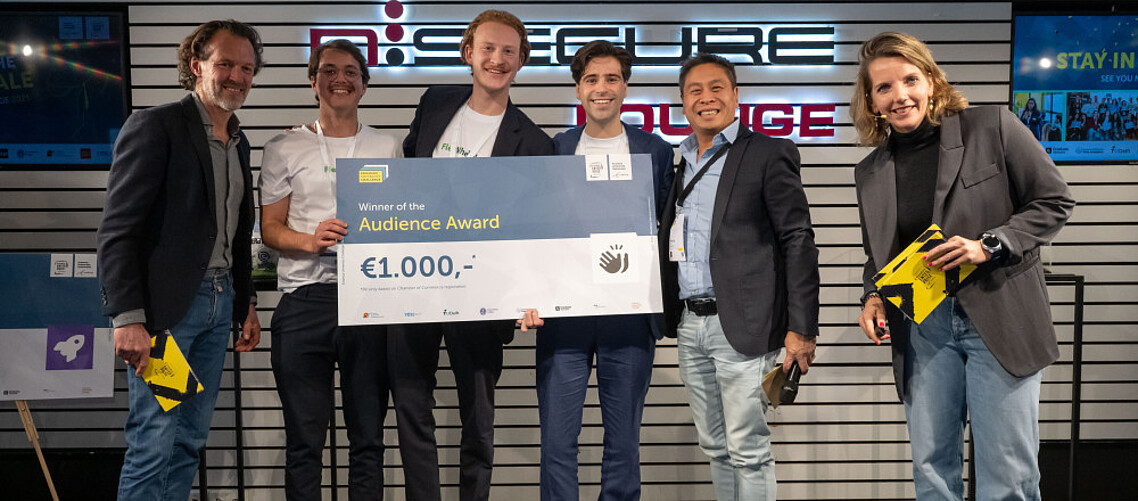
Although it shocked us to see more than 300 people show up, the final pitch and questions showdown went great! We won the Audience Award through votes and the Runner-Up Prize for startups (including a VIP ticket to the NL Startup Competition). It was an awesome experience, and I can only recommend other students to join.
One memorable moment was when Vivienne de Leeuw (CFO of the Port of Rotterdam) said, “I’ll be standing to ask my question because your pitch was really good.”
5. What plans does your team have for your enterprise?
We are now working closely with partners and investors to scale our business, and we would love to meet more people in this environment interested in urban mobility solutions. Our vision is to provide service not only in Rotterdam but across multiple cities, proving that sustainability, scalability, and flexibility can go hand-in-hand!
Meinke van Oenen, Algaenius
1. Tell us about your team.
We are team Algaenius. Meinke van Oenen (RSM) is the founder and put together the team consisting of Garret Dublado (Avans University of Applied Science) and Zoe Yap (Wageningen University and Research). We came together based on our shared passion for biobased solutions and entrepreneurial spirit.
2. Describe your enterprise – what did your team pitch during the final?
Water scarcity is one of the greatest challenges of our time. However, current solutions to fight it (by creating drinking water from seawater) are very expensive and harmful to our environment.
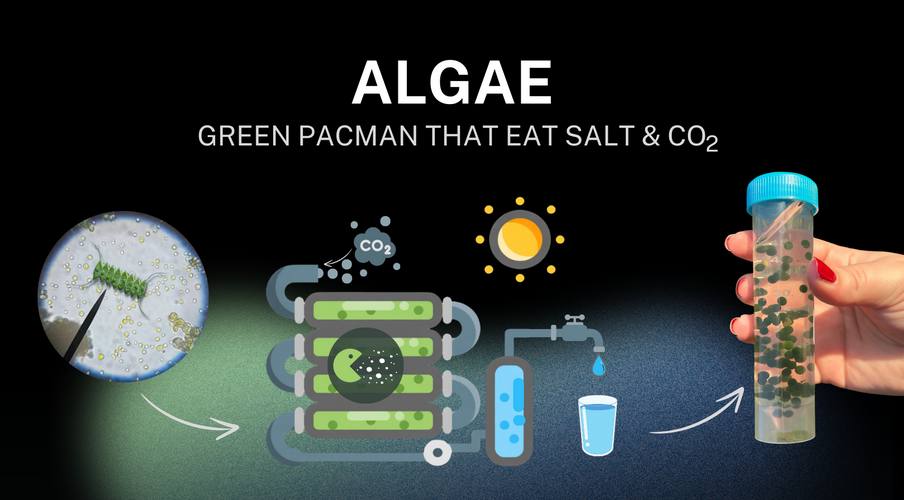
Algaenius uses special algae to desalinate seawater and capture carbon at the same time. Our method can be implemented as a pretreatment step within existing infrastructure and lower the energy demand and operational cost, thus cooling down the planet one drop at a time.
3. How did you perform in the final?
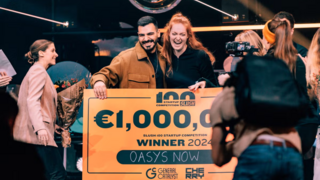
We finished as runners-up. Water technology presents unique scaling challenges due to strong economies of scale, which means development happens in many steps (10L, 50L, 250L, up to eventually 100m³/day). This often increases the perceived risk/uncertainty for judges in comparison to other sectors. We know that creating impact in a sector as unique and large as water naturally takes time. But we were very happy to see algae well represented within the competition, with the winner (SeaSparke) using seaweed (a macroalgae) to create biodegradable glitter.
4. What plans does your team have for your enterprise?
We have just been awarded the NEW-ttt grant which supports the most promising start-ups in Dutch water tech with funding for expert support and state-of-the-art research and development facilities. For this, we will be collaborating with Deltares during the second half of 2026 to further validate and scale-up our product.
5. How did you feel about your performance at the event? Was it what you expected, or easier or more difficult?
We have gotten great feedback and new connections with possible partners in the region, so we are happy with the result!
6. What advice would you give future participants?
Assume your audience knows absolutely nothing about your product and problem. Build your story and pitch from that starting point. Simplify and zoom out as much as possible to make your value understandable, recognisable, and relevant for the person you're speaking with. Especially in a competition as diverse as the EUC where you never know what the person in front of you already knows. This way you increase the effectiveness and impact of the (often) quick convos with interesting people you have.
7. How did your studies at RSM help you with your pitch?
My Business Administration education has greatly supported my pitching. It taught me that technology alone is never enough. You need a clear value proposition, a viable business model, and a credible path to scale. At the end of the day, pitching is all about convincing the audience of your value: for customers, for investors, and for society.
Our solution combines measurable environmental impact with a solid business case, which I knew was our unique selling point, so we structured our pitch around it. I would not have had these insights if I had just approached the pitch from a tech perspective.
8. How do you think this event will help your career?
I have participated in several competitions, but the EUC truly stands out because of its strong focus on business development combined with guidance from experienced entrepreneurial coaches. It pushed us to think more critically about our business model and sharpen our assumptions.
Putting what RSM has taught me into practice was extremely valuable and added another layer to my development as a Business Administration student. Highly recommend it!
Oliver Rubbens, JAW (Just Add Water)
1. Which team were you in?
Our team was called JAW (Just Add Water). The members were Oliver Rubbens (RSM), Gijs van Toor (RSM, BSc Business Administration, starting the MSc Finance & Investments next year), Flynn Lousberg, and Sam Bos. We all came together during the Entrepreneurship minor at RSM, where we quite naturally formed a team!
2. Describe your enterprise.
JAW provides healthy, nutritious freeze-dried meals designed specifically for truck drivers. The problem is clear: drivers spend long hours on the road with limited access to healthy food, often resorting to fast food or convenience store snacks. Our solution is compact, insulated meal boxes available in multiple variants (vegan, high-protein, high-calorie, and high-fibre) that require only water to prepare. No cooking equipment needed.
We distribute through trucking companies, which offer the meals to drivers as part of their daily expense reimbursement. We currently have a working prototype and multiple clients showing interest. Our mission: make healthy eating accessible for people always on the move.
3. How did you perform in the final?
We finished in third place in the Prototyping Category, which we were really proud of. What made it even more rewarding was that several jury members mentioned they would personally invest in the company. That kind of validation meant a lot to us.
4. What plans does your team have?
We're focused on building out the client relationships we've established and perfecting the product in close collaboration with the logistics companies that have shown interest. The goal is to move from prototype to a market-ready product that fits seamlessly into drivers' daily routines.
5. How did you feel about your performance?
It was definitely more work than we initially expected. The preparation and refinement leading up to the final were intense. But in the end, it was incredibly rewarding to see that effort pay off with a third-place finish.
6. What advice would you give future participants?
Put in the effort. It's easy to underestimate how much work goes into a strong pitch, but the preparation truly pays off, both in results and in what you learn along the way.
7. How did your studies at RSM help?
Our RSM studies prepared us well. The Entrepreneurship course in B2 gave us a solid foundation in business model thinking and opportunity recognition, while the Entrepreneurship minor in B3 helped us develop practical skills in validation, pitching, and building a venture from the ground up. That academic groundwork made a real difference on stage.
8. How will this event help your career?
The competition helped us develop several valuable skills. Pitching and networking were the biggest ones, as we learned to communicate a business idea clearly under pressure and connect with investors and peers. Beyond that, it strengthened our ability to work under tight deadlines, think critically about feedback, and present ourselves professionally. These are skills that translate directly into any career path.
Read more about the Challenge in Erasmus Magazine