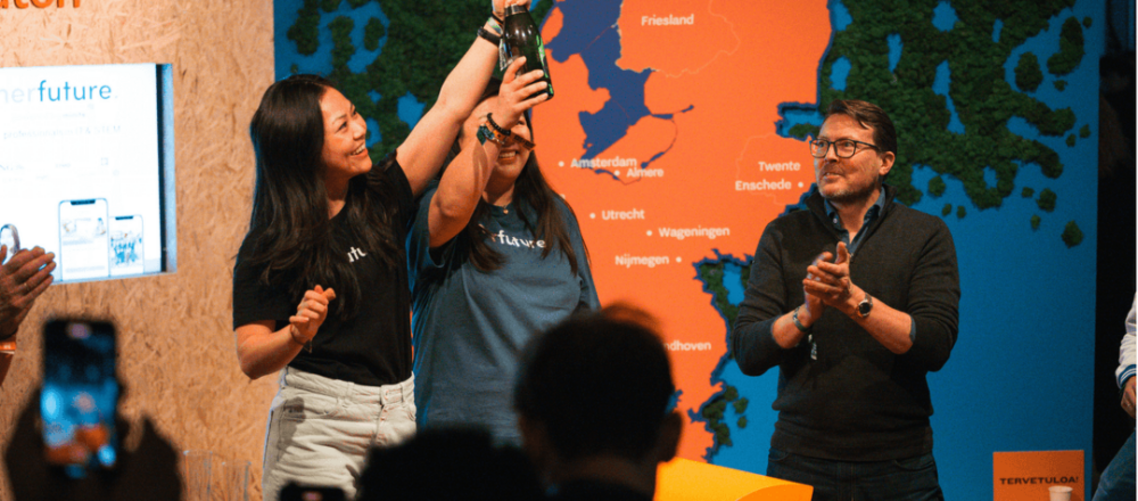
Ask Micky Chen, winner of the 2025 Dianne Bevelander Prize, why she gave up a corporate position to become an entrepreneur dedicated to social impact and the answer is simple:
“I’ve experienced formative moments early in life that shaped how I see the world. They made me realize I don’t just want to build a comfortable life for myself, but to create meaningful impact for others and for society.”
Micky’s family took a life-changing journey from Nepal to the Netherlands under challenging circumstances, rebuilding their lives from scratch. Experiencing that transition at a young age shaped her perspective early on. It made her deeply aware of both the opportunities she was given and the responsibility she feels to create impact beyond herself. It forms part of an irresistible pulse that propelled her from a promising career in business to the world of entrepreneurship, becoming the co-founder of two thriving platforms that aim to positively impact people’s lives.
An early manifestation of this impulse for impact was when Micky co-founded The New Fashion Society while still a student at Erasmus University Rotterdam (EUR). A community for students interested in a career in fashion and the arts, it has grown to be Benelux's largest student organisation for the luxury and creative industry with partners like LVMH, Karl Lagerfeld, Tommy Hilfiger, L'Occitane, Pepe Jeans, Nestle and H&M.
After completing an International Business Administration BSc at Rotterdam School of Management (RSM), and then a Master’s in Information Systems at the University of Amsterdam (which she earned Magna Cum Laude) Micky spent three years at Salesforce, working out of Amsterdam and Dublin and reaching the position of Account Executive. But an idea had been turning over in her mind since she was a student and so, in October 2020, she left the corporate world to start Minite together with her sister Linky. The platform was built to help students and companies find each other, based on data, driven by a mission to ensure fairness, inclusiveness, equal opportunities and creating study-relevant job opportunities. Just four years later, Micky and Linky’s entrepreneurial spirit raised its head again and together they founded HerFuture. A community, platform and mobile app that is built by women in tech, for women in tech, HerFuture aims to empower females in IT and STEM while helping companies reduce their gender gap.
And the Chen sisters have not stopped there: in 2025 HerFuture+ was added into their suite of offerings, taking inspiration from the success of HerFuture but aimed at mid and senior-level women in tech who had also expressed a desire to connect, learn and move forward in community.
We visited Micky at HerFuture’s homebase in the heart of Amsterdam where, together with Linky, she has created a warm, welcoming space for the organisation’s small team and its impressive roster of clients which include KPMG, Booking.com, Capgemini, Sogeti, Picnic Technologies, Netcompany, Qquest, Accenture, Van Lanschot Kempen, iTrainee, Axians, BAM, Flow Traders, Henkel, ING bank, Itrainee, Quooker, Delaware, Rabobank, Robeco, Royal SMIT Transformers and many more.
Congratulations on winning the 2025 Dianne Bevelander Prize! How did you react on hearing the news at the end of last year?
I was truly honoured. Dianne’s work continues to inspire generations of women to lead with courage and to champion those who come after them. She was a pioneer of gender equality, and her fearless leadership created space for women not only to take their place, but to rise together. With HerFuture and HerFuture+, we continue that legacy with the same conviction: when women are supported at every stage, the entire tech ecosystem advances.
Transformative moment
In her role as Associate Dean of the MBA Programmes at Rotterdam School of Management, Dianne undertook research into social networks amongst the MBA students which triggered a realisation about gender and gender bias. This ultimately led to the establishment of ECWO in 2014. Was there a similar “aha moment” for you in your own entrepreneurial journey that you can clearly identify?
One of the most powerful transformative moments that I can identify happened with Minite. The platform had been live for some time when we started noticing that there were some brilliant students in our database who kept getting rejections for positions they applied for. It didn’t take long for it to dawn on us that, because the profiles that students made when they joined the platform included photos, there was bias in who was being selected for interviews. We decided to do an experiment in which we removed the images and even the names of students, and instead they were able to choose an icon that best represented their personality – a watermelon or a cupcake or a soft serve ice cream. All the pertinent information about their skills and experience remained, and everything was attached to a unique code. We took a risk and made this change overnight. At first, some of clients thought our site was just bugging. There were a few who were not happy with the change and asked for urgent meetings. But after piloting this for two to three months we were confident that it created a fairer playing field for everyone and was therefore much more inclusive. Linky and I felt strongly that if clients left us because we implemented something we really believed in, then so be it. Quite quickly we saw how this new approach actually meant that employers took less time to get to the right candidate for the job. It was an aha moment that we have carried forward into all our work.
Can you trace the journey from Minite to HerFuture for us?
When we reached 20,000 users on the Minite platform, it marked an important milestone for us. It showed that we had built something valuable, but it also sparked a new ambition: how could we deepen our impact?
We knew that whatever we built next had to stay close to our core, but go further in truly supporting our community. That’s where the idea for HerFuture was born, as a natural next step in expanding our mission and creating more targeted, meaningful impact.
Linky and I started reflecting on our own experiences in the world of work: Linky had studied law and worked in a startup where there was a significant gender imbalance. After completing my International Business Administration BSc at RSM (Rotterdam School of Management), I had undertaken a Master’s in Information Systems at the University of Amsterdam and I had also seen significant gender imbalance in post degree opportunities and work experience. With these in mind, we decided to send a message to all the women registered on the Minite platform who were studying STEM and ask if they identified with our experiences. If they did, we then asked if they would like to join a gathering at our office to talk about how young women could connect and support each other in their early career journey. The response was amazing. In one week, we had 500 people register their interest and we eventually invited 40 to our office. The energy in the room was incredible as everyone shared stories. We knew that our gut feeling was right and that building a community was possible – and necessary. That was the start of HerFuture.
Two sisters complementing each other
The Dianne Bevelander Prize jury were impressed by the founders work you have done with your sister. Can you share a little insight into your relationship?
(laughs) Linky and I are literally like day and night! I am focused on the quantitative elements of our work, and she looks at the qualitative. For instance, if we had an event yesterday, I would want to know how many people attended and she would want to know what the vibe was like. Linky is a relationship builder and takes care of all the sales and operations. I am mostly responsible for everything on the IT and product side. We really complement each other and that is something that has really helped build Minite, HerFuture and now HerFuture+.
Minite is the foundation, HerFuture is what you have now built on it, and you launched HerFuture+ for mid and senior-level women in tech last year. Could you share some of your vision for 2026 with HerFuture and HerFuture+?
We’re seeing just how strong the appetite is. Within two months of launching HerFuture+, our platform for mid- and senior-level women in tech, 1,500 women joined the community, largely through our existing network and word-of-mouth.
For 2026, our focus is on scaling that momentum. We’re expanding both our community and our partnerships, with our next events taking place in London this June.
What’s especially exciting is that this European growth is already happening organically. We’re working with international companies like Henkel in Germany, which has become one of the most popular employers on the HerFuture platform.
The vision is to create a truly pan-European ecosystem where women in tech, across all career stages, can access the right opportunities, networks, and support to grow.
That’s impressive. But not surprising! You and Linky built your first platform when you were just seven. Can you tell us a little bit about this?
It was around 1999 and it started as a very basic Harry Potter website that our dad helped us to build because we were just mad about everything Harry Potter. Once that was done, I remember asking my dad to teach us more and soon we had this fully fledged platform where you could do different things – for instance, you could be a student and earn points by “doing homework” which you could then use to purchase a pet. At some point, my dad suggested that we should monetise the website and he helped me put up banner ads. In that way we earned our own pocket money. It was super, super fun. I guess that was our first step into being entrepreneurs!
Yes! And now, with your degrees and experience, you are able to build your own platforms …
We are. We use AI to help automate as much as we can and it is super helpful but we are very much aware of using it smartly and not at the expense of the human side of our work - which also plays a role in energising our whole team. I always say that we are tech with a human touch.
Keeping motivated in challenging times
What keeps you motivated at a time in which it feels like the work we are both doing (at ECWO and HerFuture) is at peril in some parts of the world?
I often come back to my family’s journey. Growing up, my sister and I became fluent in Dutch quite quickly, while my parents were still finding their footing. That meant we often stepped in to help navigate everyday situations, which made me aware from a young age of how important access, representation, and opportunity really are.
I also watched my parents stand up to discrimination and bias. When we moved to a new city, the principal of the primary school was skeptical, assuming we wouldn’t be able to keep up with the academic level. But my father refused to accept that judgment, which was based on nothing. In the end, my sister and I became the first students from that school to be admitted into “Gymnasium”, the most academically rigorous secondary education track. The principal was overjoyed, which made the journey all the more meaningful. Moments like these are how we slowly change bias and reshape what people believe is possible.
It’s also why I feel a strong sense of responsibility. The Netherlands gave our family the chance to rebuild and create a future, and I don’t take that lightly. For me, that translates into wanting to build something that creates opportunities for others as well.
That perspective stayed with me when I was in the corporate world. I knew I could build a great life for myself there, but I also felt the pull to contribute more broadly. That’s what continues to motivate me, especially in moments when the work feels more challenging.
That’s a profound realisation. How does that play into your own life?
I do my best to practice inclusivity and belonging, and I think that shows in the languages that are part of my life. Growing up, we spoke Nepali at home, and I learned Dutch through school and the neighborhood. I attended Chinese school because my dad’s family lives in China, and speaking Mandarin is the only way I can truly connect with them. I’ve also learnt French, as my husband is from France and his family doesn’t speak much English. I’m not fully fluent, but I can comfortably get by. To me, this is what makes the world so beautiful, all these different languages and the connections they create.
We always like to ask what our interview subjects are doing in their time outside work and would love to hear yours.
I love sports and work out around 10 hours a week. I’m also a HYROX trainer, which is a sport that combines running with functional workout stations. You run one kilometre, followed by a workout station, and repeat that eight times. It’s a lot of fun and I’m pretty addicted to it. Alongside that, I do Reformer Pilates, CrossFit, Rocycle, weight training and running. After a day of high-pressure work, being able to fully switch off and immerse myself in exercise really helps me stay balanced.