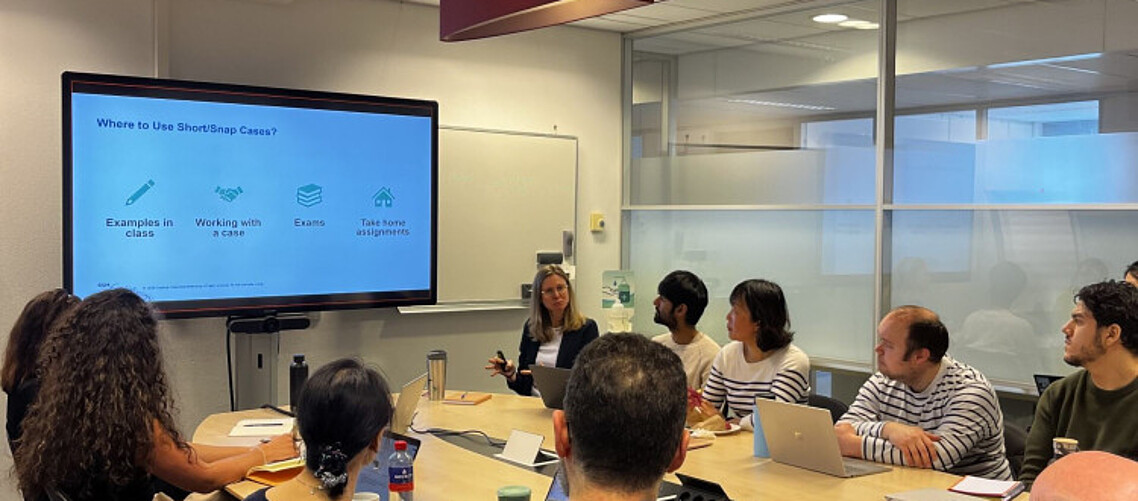
The most recent Case Community seminar, hosted by RSM’s Case Development Centre (CDC) on 10 March 2026, offered insights into developing short cases that reflect today’s complex business environment.
Case-based learning faces a growing challenge of limited student engagement. At the same time, curricula are expanding to cover an increasingly broad range of topics, driven by a rapidly evolving global landscape and the role of artificial intelligence (AI) in enabling faster learning.
That's why Dr. Klopf and Dr. Sidorovska from the Department of Strategic Management and Entrepreneurship shared their insights and experiences with creating snap cases that capture complex issues and uncertain business environments. They aim to challenge the existing idea that longer cases offer better learning. Instead, they believe that shorter, more focused cases can better engage students while still delivering valuable learning experiences.
"The snapping and putting things together works pretty well to really make them think a bit more... rather than just across the board [having] the average LLM answer." - Dr. Patricia Klopf
What is a snap business case?
Case writing experts suggest that a snap case should be no more than five pages but maintain the same essence of a classic Harvard case: a protagonist with a central decision. The biggest difference is that snap cases remove the additional information that students would typically skim over.
However, this can be difficult if students are unfamiliar with a particular industry, or when a case involves technical background information, such as legislation. A good solution is to include pre-readings, such as newspaper articles and infographics, which present ideas more clearly and visually. This allows case writers to provide necessary context without cluttering the core narrative.
What makes an effective snap business case?
The Case Community seminar explored several factors that make snap business cases successful.
1. Prioritise geographic relevance.
Students tend to respond better to companies that are relevant in their daily lives. For example, students in the Netherlands find a local retailer like Action more relatable than a distant, US-based retailer, such as Walmart. This familiarity also reduces the amount of preliminary reading necessary to support the case, as students already know the company and its environment.
2. Data is worth a thousand words.
A well-placed graph or media/newspaper snapshots can be more impactful than a page of heavy text. This allows students to base their ideas on hard, factual evidence and develop their own ideas rather than basing their decisions off the narrative alone. Furthermore, this data can also be anonymous or fictionalised to protect privacy and to target learning goals that real-world data may not perfectly illustrate.
3. Create a routine.
Effective snap-case development is a muscle that can be strengthened with repeatable routine. Dr. Sidorovska discussed her tactic of building short cases through finding an EU commission change relevant to the learning objectives and selecting a business impacted by it. She has optimised her short- case development strategy so well that she can now write a case in a day.
4. Try different classroom tactics.
A key part of improving engagement in class also comes from ensuring the class has read the entire case is key to increasing engagement. One method is to divide the class into groups and assign each group a different section of the case. The groups then present their findings to their peers, ensuring students pay close attention to detail and collectively understand the case’s essential components.
5. Use AI for multi-modal learning.
Another method of enhancing class engagement could be through creating the cases on alternative media. For example, case reading can be better tailored to today’s students by using NotebookLM or Jellypod to create podcasts or Synthesia or invideo AI to create videos. Generative AI can be an exceptional tool for creating synthetic data and fictional scenarios, if the content is verified before it’s distributed to students.
Get involved
The CDC offers comprehensive support to faculty and teaching staff interested in transforming their research or professional experiences into impactful learning materials. If you have an interesting project and are looking for ways to maximise its impact through a teaching case, please contact the CDC. Our experienced case writers can help you brainstorm case ideas, design the classroom application, and guide you through the development process.
With over 15 years’ expertise in case development, the CDC can help adapt your research or practical work for educational use, provide professional writing assistance, and facilitate publishing and promotion to broaden reach and increase impact. Getting the CDC involved early can not only ensure an efficient case development process, but it can also spark new ideas and improve your chances of acquiring external funding.
The Case Community seminar is part of the CDC’s quarterly seminars on Creating Memorable Cases. Join the RSM Case Community to stay updated on future seminars.