Cas van Liempd
Nationality: Dutch
Job title: Chief Financial Officer of Steinweg Netherlands
Programme and graduating class: Executive MBA Class of 2023
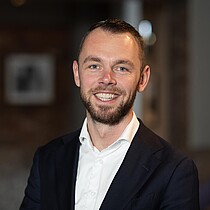
Cas van Liempd (Executive MBA 2023) is Chief Financial Officer and statutory board member of Steinweg Netherlands, part of the international Steinweg Group, a logistics services provider specialising in the storage, handling and transportation of commodities and other goods.
Alongside his responsibilities for the Dutch organisation, he is involved in international finance, corporate development and strategic projects at Group level. In this interview, he reflects on his transition from finance professional to executive leader, the impact of his Executive MBA and his perspective on leadership and long-term value creation.
Tell us about your professional journey. Where were you in your career before you started your MBA, and where are you now?
I started the Executive MBA in 2021, after I had already built a strong foundation in finance at a relatively young age. I was taking on increasingly broad management responsibilities within Steinweg. I was leading the finance department of about 30 FTE employees.
In early 2024, I was appointed CFO and statutory board member of Steinweg Netherlands.
Today, my role is much broader than finance. I am responsible for the strategic direction, organisational transformation, capital allocation, investments and divestments, digitalisation, people and organisational topics, governance and the overall performance of the business. This increasingly requires connecting financial performance with broader strategic themes such as sustainability, technology and AI, and translating these into concrete investment decisions and long-term value creation. At Group level, I am also involved in international finance, corporate development and strategic projects.
Looking back, the journey has been from a finance-focused career towards a broad executive role in which finance is still an important foundation, but strategy, leadership and execution are equally important.
What made you want to do an EMBA at RSM?
Before I applied to RSM, I happened to meet one of the professors from the EMBA at an event. I didn’t know him beforehand, but when we started talking about the programme, he used a metaphor that has stayed with me ever since.
He told me: “Let’s say we’re all sheep in a field, working on our careers in the environment we know. When you start the Executive MBA, we take you out of that field for two years. We challenge you, push you outside your comfort zone and fundamentally change the way you think. There will be plenty of ups and downs, and it will be demanding. But by the end, you have become a lion. And then we put you back into the same field.”
Of course, it was deliberately provocative, and told with a good sense of humour, but it stuck with me. The programme was not being presented as simply another academic qualification, but as an intensive development journey that could fundamentally change the way I thought, led and approached business.
I remember thinking: this is exactly what I want to do.
Beyond that initial trigger, I also had a very clear professional reason for doing the programme. I wanted to accelerate my development from a finance professional into a broader business leader. I was relatively young when I started the programme, and I deliberately wanted to expose myself to disciplines, people and perspectives outside my existing experience. RSM offered exactly that combination of academic development, practical relevance and personal leadership development.
What did you gain from the EMBA?
Three things stand out.
First, breadth. It helped me look at business issues from an enterprise-wide perspective rather than primarily through a financial lens. The programme strengthened my understanding of strategy, organisational development, leadership, digitalisation, sustainability and long-term value creation. It also gave me a broader framework for thinking about how technological developments can change business models, decision-making and the way organisations operate – a perspective that has become increasingly relevant with the rapid development of AI.
Second, perspective. Working with experienced professionals from different industries, functions and cultures continuously challenged my own assumptions. You discover that there is rarely only one way to approach a complex business problem. An Executive MBA does not necessarily teach you one right answer. Instead, it exposes you to different perspectives and frameworks, which help you develop a more considered approach to complex issues. I have found that particularly valuable in my work today.
Third, and probably most importantly, leadership development. The Personal Leadership Development component was particularly valuable to me. Technical knowledge is important, but as your responsibilities increase, your effectiveness increasingly depends on how you lead, communicate, make decisions and bring people with you.
That combination has had a lasting impact on how I operate as an executive today.
How has your career changed or developed since your MBA?
What has changed most is not only the breadth of the topics I work on, but also the level of accountability: making decisions at board level, balancing different stakeholder interests and ultimately being responsible for the outcomes. That requires balancing different stakeholder interests, making decisions that are not always straightforward and ultimately being accountable for the outcomes. It also means leading across disciplines and understanding the business beyond financial performance alone.
Alongside my executive responsibilities, I also became a supervisory board member at CTVrede, a multimodal container transport company.
Did you plan these career changes or did you find new opportunities after you graduated?
The Executive MBA helped me prepare for opportunities before they arose. That is an important distinction. You cannot plan every next position, but you can make sure that when an opportunity presents itself, you have developed the capabilities and perspective required to take it on.
My career developed faster than I could have mapped out in detail when I started, but the general direction was certainly intentional.
What is your goal for the future?
My ambition is to continue developing as an executive and to contribute where there is a meaningful combination of strategy, transformation and long-term value creation.
One principle I often come back to as a CFO is that the most important assets of an organisation are its people – yet you will never find them on the balance sheet. Financial performance, technology and strategy are essential, but ultimately it is people who turn those things into results. As my career develops, I want to remain equally focused on both sides: building high-performing organisations while creating an environment in which talented people are trusted, challenged and given the opportunity to grow.
I am particularly interested in how established organisations can successfully evolve: becoming more data-driven and digitally enabled, using AI pragmatically to improve decision-making and productivity, strengthening capital discipline and operational performance, and integrating sustainability into investment decisions and long-term strategy. For me, this also means staying close to the business and understanding how value is actually created for customers.
Are you still in contact with people from your cohort?
Yes. One of the strengths of an Executive MBA is that you go through an intensive period together with people from very different professional and personal backgrounds.
Over time, I have built a network of people working across different industries, functions and areas of expertise. For almost any significant business challenge I encounter, there is someone I can call who has relevant experience, specific expertise or simply a different perspective on the issue.
It challenges my thinking, helps me avoid looking at a problem solely through my own lens and ultimately improves the quality of my own decision-making and work.
For me, that is one of the lasting benefits of the Executive MBA: the learning does not stop when you graduate.
Are you active within the RSM alumni network? Tell us how you stay connected!
I stay connected with RSM and with people from the broader network, both directly and through alumni activities and professional networks.
I also enjoy staying connected to RSM because I believe alumni can play a role in sharing practical experiences with current and prospective participants.
Do you have advice for current and future EMBA students based on your experience?
Do not approach an EMBA primarily as a qualification. Use it as an opportunity to fundamentally broaden how you think.
Be curious about subjects outside your own expertise, actively seek perspectives that challenge your assumptions and take the leadership and personal development elements as seriously as the academic ones.
I would also encourage students to apply what they learn immediately. The real value comes when concepts discussed in the classroom influence decisions you make at work the following week.
Finally, invest in your cohort. Some of the most valuable learning takes place outside the formal curriculum, through conversations with people who have completely different experiences from your own.
How do employers benefit from employing someone with an MBA, or from someone who wants to do an MBA?
The greatest benefit is not simply additional business knowledge. A strong Executive MBA helps people connect different disciplines and understand the organisation as a whole.
That becomes particularly valuable as people move into senior leadership positions, because most important business challenges do not fit neatly within one function.
Ultimately, an Executive MBA can help develop leaders who are better equipped to deal with complexity, make balanced decisions and translate strategy into execution.