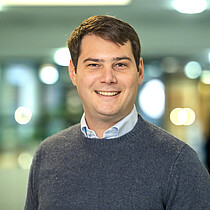
Aymeric Gillard
Nationality: Belgian
Last job title: Naval architect
Previous degree: Master of Science in Naval Architecture and Marine Engineering from University of Southampton
1. Why did you choose to go back to school for an MBA? And why did you choose RSM?
After five years working in the maritime industry as a naval architect and project manager, I was eager to broaden my leadership and business insights to make a greater impact in this field. As someone with an extensive technical background, I’m confident that RSM can provide the skills and knowledge I need to advance in my career.
At this stage, I can already see that pursuing an MBA at RSM is highly beneficial. This programme is empowering me to stay connected with the marine industry in the Netherlands, reconnect with Europe, and bridge existing knowledge gaps to expand on my career. I am also developing essential commercial skills and gaining valuable management experience, both of which are crucial for the next phase in my professional journey.
2. How is the International Full-time MBA preparing you to do business in an uncertain world?
At various times throughout the MBA programme, RSM has granted my cohort and me access to industry speakers and presented us with opportunities to attend lectures that have been genuinely of interest. From Paul Krudman discussing ‘The New Economic Order’ to industry leaders in my field, such as Peter Drake, who spoke on a panel during a talk about ‘Resilience During Geopolitical Uncertainty’. Presentations like these are helping me to develop my thinking about how to become a more impactful leader and how to deal with surprises, both post MBA and within my new role in the ever-changing maritime industry.
From these kinds of experiences, I am gathering different business perspectives and learning how to get the right mix of people into the room for a conversation. I’m very much in a technical role right now, and the MBA gives me the business backing and knowledge to go into a more commercial role after graduation.
3. How would you describe your RSM FTMBA experience so far?
The programme itself is very international – which I like – with a diverse cohort from a wide range of professional backgrounds. I think I had an easier time moving and acclimating to the Netherlands because I came directly here from my previous role abroad. Rotterdam itself is such a large maritime centre, and because that is my main field of interest, I felt I fit in here from the start.
4. What aspects of living and studying in Rotterdam do you want to keep in your life after the programme?
The food culture was a bit of a shock! I did not expect it to be so different from Belgium, where I'm originally from. With that said, the lifestyle is very healthy and balanced. I enjoy cycling every day to and from the university. Cycling here is a pleasure, even through the snow, rain, hail and heat. Additionally, it is very easy to visit the many green spaces located in and around Rotterdam; I enjoy connecting with other people in those outdoor environments.
5. What has been the most inspiring or challenging assignment or course during the FTMBA so far? How did it challenge you?
For me, the Markstrat project was a real challenge because it was about balancing the different strategies and answers that can be used in marketing. As a trained engineer, in most instances, there is only one answer: the correct answer. At the start of this project, I was interested in applying the strategies taught in class within the team, and the simulation within a team with differing opinions.
Throughout the project, our team saw varying results, competed against other teams, and went up and down in the team rankings. This created some wide swings and challenges in a competitive environment in which we all wanted to be the best. For me, this was one of the main highlights of the programme.
The Corporate Finance course also proved to be a challenge. Because my background is not in finance, I had to learn most of it from scratch. On the plus side, I have been able to immediately apply what I learned to my work. The course concluded with an extremely useful formal interview with industry experts about our valuation of a specific company. At that time, we each exchanged our ideas with the experts, got some pushback on our thoughts, and answered questions about the growth of the company and why we made certain assumptions.
6. In what way has the Personal Leadership Development (PLD) component of the programme affected you?
I think Björn Atterstam is a great teacher. I enjoy having a course that challenges me to think differently about leadership.
In my previous role, leadership was very top down. PLD has helped me to think about leadership as bottom up and as encompassing all points of view. This component has pushed me to take into account the points of view of my classmates and peers and has encouraged me to open up and truly listen. Extremely valuable skills to have if you are going into a more European-based business environment and to get the other people in the room on board with your ideas.
7. How are you planning to create impact through business or in an organisation?
I aim to improve the way companies are incentivised to stand by certain Sustainable Development Goals (SDGs) and to steer them on how they can implement these goals in their organisations. To achieve this, I am formulating a plan through my MBA project, The Craft of Managing for Positive Change (TCM). Additionally, in my work, I am analysing how I can apply in my ship designs the European carbon tax emissions scheme from the EU Emissions Trading System (ETS).
As a ship designer, I have to consider solutions like how to decrease the vessel’s noise underwater and how to reduce its output of pollution and methane into the air. When I think about what SDGs resonate the most for my work and personally, I choose number 6 – Clean Water and Sanitation – and number 14 – Life Below Water. These correlate with my MBA project, work, and future endeavours, and these SDGs reflect my personal values.
8. How have you utilised the alumni network so far?
Yes, very much so! For example, I’m currently co-president of the RSM Sailing Club, which is half alumni, half current students. Here, we bring students into the sailing world through our beginner classes. There are also overseas events which are run by alumni clubs from other universities, where club members get exposure not only to their own alumni but also to alumni from other business schools in Europe.
The RSM Sailing Club tends to get up to 50 alumni joining our events, ranging from our mid-summer BBQ to our Kings Day event to our Malta event, which we hosted in June 2026. It’s a great learning experience. The alumni have shared advice from their time as an RSM MBA student, talked about how to maximise the use of an MBA from RSM, and given me insights on the best ways to expand my network.
9. How has the Career Development Team helped you on your journey?
The Career Development Team have been excellent at bringing in industry experts for lectures. Throughout the year, they have also organised interesting and informal talks that have enabled me to broaden my horizons and interact with industries I had limited or no connection to before that time. A good example of this was when I joined a talk with some prominent FMCG managers and directors – it was fascinating to hear about the real challenges they were facing in China, for example, and how they could still increase their sales even though that was their biggest market.
10. What advice could you give to people who are considering doing an MBA?
In my view, an MBA from RSM is excellent for those who want to make a change, and for those who want to transition their career from a broader role into a more commercial role.
For me, as a person who was always very technical, this MBA study was fantastic! It helped me to step into a different perspective in a school setting, which I found to be really useful. It is important to continuously develop and learn in your lifetime, so that you're able to grow further in the future. The RSM MBA programme helps you do that.
11. What's next for you?
I truly believe this MBA study has put me on the right path in terms of achieving my long-term goals of developing myself into a senior manager. I want to manage and take care of a team, and to understand their dynamic and determine what is the best for the performance of the team. This programme has really helped to put me on the right track and has added a solid business aspect to my portfolio that will help me transition to commercial roles.
I will most likely go back to working in the marine industry, but no longer as an engineer. I have a more commercial role in my sights for the next two to three years. I am not fixed geographically; for example, I could go back to Hong Kong or I could stay in Rotterdam.