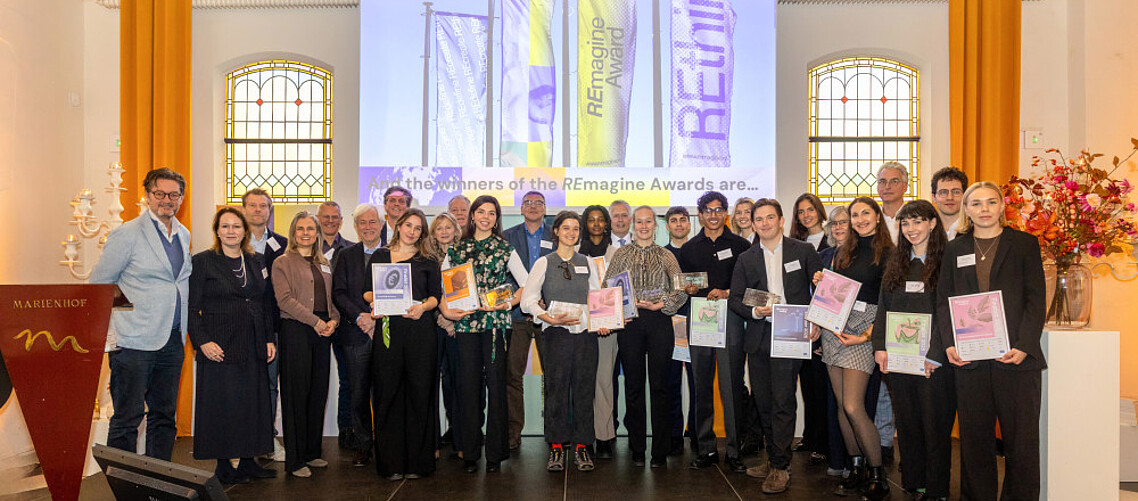
The REmagine Awards are an initiative of the Deans’ Board for Economics and Business (DEB), a collaboration of sixteen deans from Dutch universities. The awards are supported by the Goldschmeding Foundation. With this thesis prize, the organisers aim to encourage a new approach within their fields: they call for education and research that address current societal challenges, with not only economic value creation but, above all, societal value at the centre.
DEB Chair and Dean of Economics and Business at the University of Groningen, Peter Verhoef, explains: “Each year, more than 10,000 Master’s students graduate with a dissertation in these disciplines. They then take the knowledge acquired during their studies into practice. Imagine the fundamental role that economics and business education can play in training a generation that focuses not only on profit and growth, but also on broad prosperity. With this prize, we are not only honouring individual achievements, but also showing the power of fresh perspectives to drive positive change. The award thus forms a bridge between science and society.”
From 103 submissions, fifteen finalists were selected across five different impact themes. During DEB Impact Day, the finalists presented their research, after which an expert jury announced the five winners of the REmagine Awards. Each received a specially designed crystal award and an unrestricted cash prize of €5,000.
REmagine Awards 2025 Prize Winners
Jard Swinkels (RSM, Erasmus University)
Winner: Institutional Adaptability theme
Trust, shared ambition and a willingness to invest together determine whether major transitions—such as the energy transition—succeed. Swinkels developed a practical measurement system for the Port of Rotterdam that makes these ‘soft’ factors visible. The system can help businesses and governments work together more effectively by systematically measuring relational dynamics.
Kavin Varadharajulu (ESE, Erasmus University)
Winner: Future Health and Healthcare theme
Varadharajulu developed an AI system that can assess whether someone is at risk of diabetes using just five questions, compared with the twenty questions used in traditional questionnaires. Its application could make early detection affordable and accessible, before complications arise. His research shows that AI systems can contribute to better healthcare—provided they are carefully designed and deployed fairly.
Karlijn van Dijken (University of Groningen)
Winner: Sustainable Economy theme
What is the hidden climate impact of the journeys products take? Van Dijken analysed more than a thousand international supply chains and made the climate impact of these complex chains measurable. Her research shows that the current practice—where companies only hold their direct suppliers accountable for sustainability—falls fundamentally short, and that real progress begins with insight into every link in the supply chain
Maite den Butter (Wageningen University)
Winner: Broad Prosperity theme
Den Butter’s research demonstrates that marine protected areas not only restore nature, but also improve the wellbeing of residents in coastal villages in Papua. Her analysis of more than 1,000 villages over thirteen years shows that ecological restoration can go hand in hand with improved drinking water quality, greater safety and stronger communities. The study emphasises that conservation is most effective when local residents are involved in decision-making.
Marie-Anne de Gier (Leiden University & Delft University of Technology)
Winner: Responsible Digital Transformation theme
What is the impact of digital innovations in Dutch high-tech factories on sustainability? De Gier developed a tool that clarifies when technology contributes to sustainability and when it may actually increase environmental pressure. Her tool is already being used by companies to make more conscious choices about which digital investments truly make a difference.