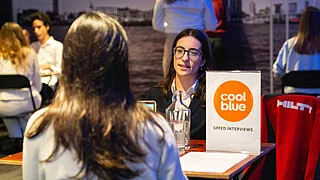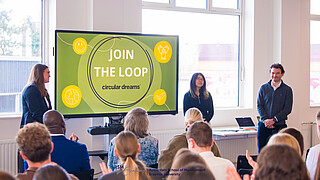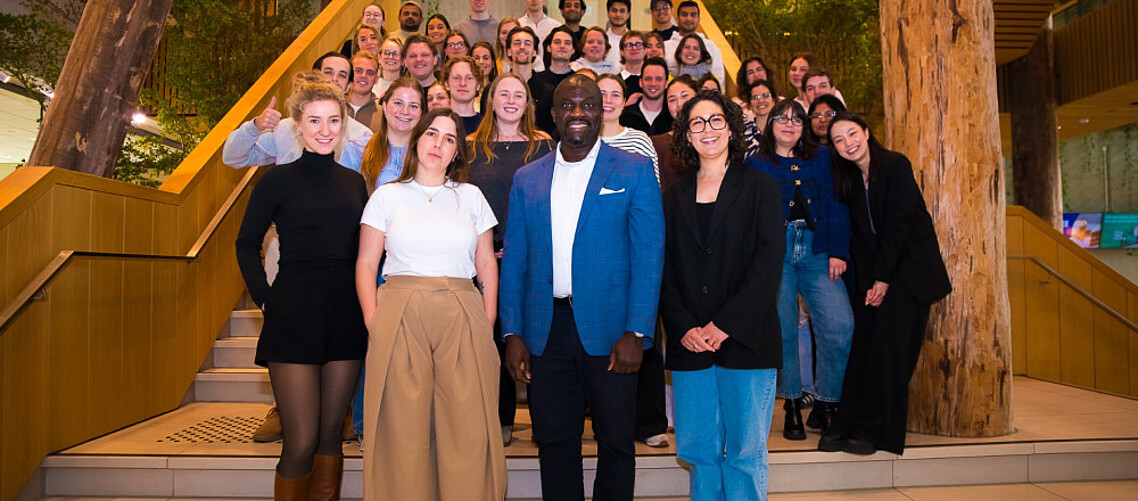
This event marked the culmination of RSM’s Sustainable Business Models elective course for the MSc Global Business and Sustainability (GBS) programme. The elective course equips students with practical skills to design impact-driven business models. Prior to the final event, the students spent six weeks working in 12 teams on proposals to help the four organisations strengthen and scale their positive impact.
After receiving their briefings in early February, the student teams engaged in a mix of activities to understand the complexities of their assigned companies. Through a combination of lectures, workshops, games, site visits and real-world business cases, the students learned to analyse, evaluate and redesign business models to create sustainable value for organisations and society.
A bridge between academia and practice
For many, the experience of working as a consultant for a real organisation proved more meaningful than a purely theoretical assignment.
Lisa Marie Josten, whose team worked with Floating Farm, said, “Working on a consultancy project for a real company was a very fulfilling experience. It gave us the opportunity to develop a real and innovative solution... this made the project feel far more meaningful. Presenting our solution to the company challenged us to think beyond academic concepts and focus on ideas that were realistic, relevant and applicable in practice.”
Charlotte Mathy, representing a group advising The Social Hub, agreed that the stakes felt higher than with a typical classroom assignment. “Knowing that we would present our solution to someone from The Social Hub pushed us to be more critical and realistic in our analysis and recommendations,” she said. “We had to consider feasibility, stakeholder perspectives and how the proposal would fit into the company’s existing operations.”
Fresh perspectives for innovative organisations
The four participating organisations were impressed by the GBS master students' ability to quickly grasp the realities of their operations and offer creative, practicable solutions.
Carla Wessels, Marketing & Communications Director at The Great Bubble Barrier, noted, “As a social enterprise, we think a lot about how to build a business model that is both financially sustainable and genuinely impactful. Participating in the Impact Event allows us to contribute to the conversation with the next generation of business leaders and gain an outside perspective on our organisation. Each team's proposals were thoughtful and grounded, and between them they produced nine recommendations that, in different ways, were worth taking seriously. For a small organisation, having that kind of structured external input is genuinely useful.”
For Lena Burgdorf, Strategic Project Manager at Orbisk and a GBS alumna, the collaboration was inspiring. “As a student, I loved the collaborations with real companies during the GBS master programme. Having built a sustainability-focused career, I’m grateful that I now get to give back by participating from the organisation's side. It's a challenging task to come up with something truly innovative for a company that’s, of course, already constantly evaluating all potential opportunities to improve and grow in a sustainable way. But the students did a great job at striking a balance between the reality of the business world and thinking outside the box of what still might be possible now or in the future.”
Transforming sustainable goals into business reality
Students proposed diverse strategies to create sustainable value for the organisations.
Working with Floating Farm, student Ina Ilkova explained that her team’s proposal leverages the farm's educational potential by introducing a structured programme for schools. “Economically, this would create a stable and predictable revenue stream, helping address the break-even goal of the Rotterdam farm,” she said.
Minke van Wingerden, CEO of Floating Farm, left the event with enthusiasm, noting, “It pushed me to rethink some ideas we had in the past. We will look into the opportunities for high-school lessons about circularity, sustainability, and world food systems. We’ll also work on how we can upgrade or reuse buttermilk – especially since we won a golden award last week for our butter!”
One of The Social Hub groups focused on strengthening the supply chain by making procurement more collaborative, transparent and data-driven. RSM team member Hidde Suurenbroek said, “We recommend joining industry initiatives such as the Hospitality Alliance for Responsible Procurement (HARP) and implementing digital ESG monitoring through platforms like EcoVadis. We also suggest integrating impact storytelling into the guest journey to communicate the value created through responsible sourcing. Together, these improvements aim to reduce supply chain emissions, enhance supplier relationships and turn sustainability into a visible and strategic part of The Social Hub’s value proposition.”
Meanwhile, Charlotte Mathy's team proposed a loyalty programme to encourage sustainable behaviour among guests. “The programme would allow them to earn points for actions like attending events, joining community activities, and practicing sustainability, such as waste sorting or reuse initiatives. They could then redeem these points for discounts on future stays, services, or experiences provided by The Social Hub or its partners.”
Amber Westerborg, Director of Sustainability & Impact at The Social Hub, met the ideas with interest. “I thought the proposals were great. Each of the teams focused on a different element of The Social Hub’s business, and I felt the teams thoroughly understood our operations and what levers we can pull to improve our business model. All the proposals contained recommendations that are feasible and could be implemented in the near future. I’m excited to share their ideas with my colleagues!”
Key takeaways for business leaders of today and tomorrow
For the students, the project highlighted the complex, collaborative decision-making required in the real world. Hidde Suurenbroek said, “The biggest takeaway is that sustainability is much more complex in practice than it appears in theory. We learned that improving sustainability, especially in the supply chain, requires collaboration, data and gradual implementation rather than quick solutions.”
Lisa Marie Josten added, “Our key takeaway was how challenging it is to identify a strategic step that is not only sustainable and innovative, but also realistic, valuable for the company, and ideally able to strengthen its long-term business potential.”
For the four organisations, working with the RSM student groups for the Sustainable Business Model Impact Event provided an uplift of inspiration. Lena Burgdorf noted, “I got so much energy from working with these ambitious and driven sustainability students. If our future lies in their hands, I'm hopeful.”
Dr Taslim Alade, Senior Lecturer and the elective course coordinator, said, “By fostering these direct collaborations, RSM strengthens its connection to the local innovation ecosystem, ensuring that the transition toward more sustainable business practices is driven by evidence-based, innovative ideas.”