

Academic skills: Basic curriculum
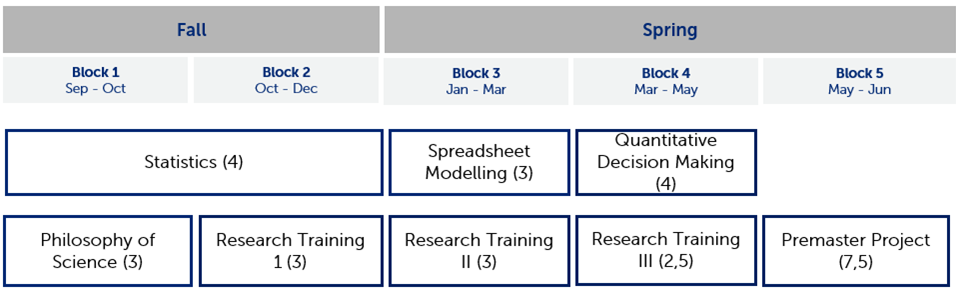
The curriculum (30 ECTS) has been designed to enhance your academic research skills, which will be needed during your master studies at RSM. The content of the premaster is the same, regardless of the master programme you plan to follow after.
The English language premaster programme is taught fully online.
Course overview 2026-2027
English Language Premaster (online) | |
|---|---|
| Duration | 30 ECTS, 12 months
Special rule for students with a Dutch study residence permit
|
| Diploma | The premaster programme will prepare you for entry to one of RSM's master programmes, but you will not receive a diploma upon completion of the premaster. |
| CROHO* code | 50952 *Centraal Register Opleidingen Hoger Onderwijs |
| Maximum capacity | 190 students |
| Fees | The minimum tuition fee for the premaster in English Language (online) as of the academic year 2027-2028, is
Note: Tuition fees indicated are subject to change. Prior to the start of the academic year, tuition fees may be modified by the Dutch government. Erasmus University Rotterdam reserves the right to make changes affecting policies, fees, curricula, or any other matter announced in this publication without prior notice. Check the website of the Erasmus Student Service Centre (ESSC) for more information on tuition fees. |
The application process for the September 2027 intake of the English language premaster programme opens on 1 October.
- Application deadline: 15 May or earlier if the programme is full
- Date closed last year: 2 April 2026
- Admissions Process: rolling admissions
- Programme capacity: 190 enrolled students
- Number of applications allowed before application closes: 342
- Current number of applications: 0
Why is the number of accepted applications higher than the programme capacity?
RSM has calculated that if 342 students are allowed to submit an application, the number of enrolled students will stay within the limit of 190. This is based on the quality of applicants from previous years and the expected number of students who cancel their enrolment before the start of the academic year. There is no waiting list for students who miss the application due to programme being full.
When did the application close last year?
Last year the application closed on 2 April. We advise you to submit your application as soon as you meet the minimum admissions requirements, including GPA, English and GMAT test results (if applicable). Plan your English and GMAT tests well in advance!
What happens when the maximum number of submitted applications is reached before the 15 May deadline?
Once the maximum number of submitted applications is reached, the application will close. No more applications will be accepted. Only complete applications submitted before the application closed will be considered for admission. Applicants who meet the minimum requirements, will receive an offer of admission on a rolling basis.
What if the number of submitted applications is lower than the maximum on 15 May?
Application for all programmes will close on 15 May. After this date new applications will not be accepted, even if the programme did not fill up.
For the premaster programmes RSM accepts applicants with a bachelor obtained at an accredited University of Applied Sciences in
- Austria, Germany & Switzerland (Fachhochschule - FH),
- Belgium & the Netherlands (Hoger Beroepsonderwijs - HBO),
- Finland (Ammattikorkeakoulu - AMK)
- Sweden (Högskola), Norway (Høgskole) and Denmark (Professionshøjskoler)
RSM also welcomes students to the premaster who have completed their bachelor at a research university, but are missing the required content in qualitative & quantitative research methods and statistics.
If you have completed your bachelor studies in China, please note that RSM only accepts bachelor’s degrees from a specific group of Chinese universities.
It is not necessary for you to have completed your bachelor studies at the time of application, but all requirements of the bachelor, including the final thesis (if applicable) must be completed before the start of the premaster (31 August).
During the admissions process, the RSM Admissions Office will assess your academic background and determine which MSc programmes you may continue to.
In general:
- Applicants with little or no previous academic background in business administration can continue to:
- Master in Management
- Part-time Master in Management (Dutch only)
- Management of Innovation
- Medical Business and Innovation
- Business Analytics & Management
- Applicants with a bachelor's degree in psychology or sociology can also continue to:
- People, Organisations & Change
- Applicants with a broad background in business administration can generally continue to most of the MSc programmes, provided they meet the programme-specific admission requirements.
- Applicants with a specialised background in business administration, such as human resource management, logistics, or finance, can generally continue to many, but not all, MSc programmes.
For more information on the different master programmes, please visit the MSc programme pages.
Mathematics & the premaster: While there isn't a specific requirement for mathematics, we do recommend that applicants with a background in the Dutch education system, have obtained at least havo level mathematics A or B.
Check below which requirement applies to your diploma type:
Students who will obtain a bachelor degree at a Dutch University of Applied Sciences can be admitted with a minimum grade point average (GPA) of 7.3.
- At the time of application RSM calculates a Weighted Grade Point Average based on the final three years of the bachelor programme also known as the main phase.
- If you are following a fast-track programme (three years instead of four), the first year of the programme (propaedeutic year) will always be included in the GPA calculation.
- If the grades of the first year of study (propaedeutic phase) improve the GPA, RSM will add those grades to the calculation.
- Additional grades obtained at a Dutch higher education institution during a second bachelor degree, master programme, or extra minor can be added to the GPA calculation for the benefit of the applicant.
- Credits and grades that have been transferred from a previous study (such as an associates degree), must always be included in the application and will be added to the GPA calculation.
- It is not possible to compensate for an insufficient GPA with work experience, certificates or other non-academic experiences.
- Grades earned outside of the Dutch education system, for example during an exchange semester, will not be converted, as grades are culturally determined and not transferable. They will only be considered for the GPA if they are already translated by your home institution and added to the grade list.
If your GPA does not meet the minimum requirement at the time of application, you can still apply, but you need to obtain a sufficient GPA before the application deadline of 15 May, or before the programme has filled up (which can happen before the regular application deadline). Students who meet the minimum GPA requirement at the time of application are given priority.
Applicants who will obtain their bachelor diploma from a research university outside of the Netherlands must submit a GMAT test result with the minimum score of 565.
Frequently Asked Questions:
Can I apply first and submit my GMAT results later?
I have a GRE score; do I have to take a GMAT?
Is my GPA Sufficient for admission?
In order to guarantee the required minimum level of English proficiency, an applicant must be able to show proof of proficiency on at least C1 level (according to the Common European Framework of Reference for Language - CEFR). You can submit your application first without the English results but they must be submitted by the application deadline, or before the programme has reached maximum capacity (whichever occurs first). English proficiency can be proven in different ways:
Secondary education (High School):
- The official language of instruction was English and the diploma was obtained in one of the following countries: UK, USA, Canada, Australia, New Zealand, South Africa or within the EU/EEA including Switzerland.
- If it is not mentioned on the diploma, or on the website of the school that the programme was taught completely in the English language, an official statement provided by the school is required.
International diplomas accepted:
- International Baccalaureate (IB) Diploma if the official language of instruction was English
- International Baccalaureate (IB) English certificate: English A Higher Level certificate with a minimum grade of 6 or English A Standard Level Certificate with minimum grade of 7
- European Baccalaureate (EB) Diploma with a minimum grade of 7.0 for English (language 1)
- GCSE / A-level with a minimum grade of C
You can use your bachelor degree as proof of english proficiency if:
- The degree programme was taught completely in English in one of the following countries: USA, Canada, Australia, New Zealand, South Africa or within the EU/EEA including Switzerland.
- If the programme was taught in two languages (for example Dutch and English) you must show proof that English was the official language of instruction for at least 120 ECTS. This equals two full study years if the bachelor is a three year programme. Courses taught “partially” ,“mostly” or "sometimes" in English will not be counted.
If it is not mentioned on the diploma, or on the website of the university that the programme is taught in English, an official statement provided by the university is required.
You can use your master degree as proof of English proficiency if:
- Your master degree programme was taught completely in the English language in one of the following countries: UK, USA, Canada, Australia, New Zealand, South Africa or within the EU/EEA including Switzerland
- and you have completed this degree at the time of applying to RSM (you need to have obtained 60 ECTS of your master in order to use it as proof).
If it is not mentioned on the diploma, or on the website of the university that the programme is taught completely in the English language, an official statement provided by the university is required.
RSM accepts a C1.1-level (CEFR) English course or test completed at an accredited University of Applied Sciences or research university within the EU/EEA. The course or test must cover all four language skills: reading, writing, listening and speaking.
Accepted forms of proof
You can provide one of the following:
- Grade list/transcript: the English course or test is clearly listed on your official grade list, including the obtained C1.1 (CEFR) level.
- RSM English Proficiency Form: download the form here and ask your university to complete and sign it.
- Course or test certificate: the certificate clearly states the obtained C1.1 (CEFR) level.
- Official statement from your university: the statement confirms the obtained C1.1 (CEFR) level.
In all cases, the course or test must cover reading, writing, listening and speaking.
Test results must be no older than three years at the time of application.
Online placement tests, such as OLS (Online Language Support for Erasmus+) and the Oxford Online Placement Test, are not accepted.
A course or assessment via Erasmus University Rotterdam
The Language & Training Centre (LTC) offers English assessments and C1.1-level English courses throughout the year. Both the overall level as well as individual skills must be at C1.1 level.
Standardised tests accepted by RSM:
IELTS: Academic test (including IELTS Online) with a minimum overall score of 7.0 and minimum sub scores 6.5.
TOEFL (iBT): minimum overall score of 95, with minimum subscores of 5 (22) for Reading and Listening, 5 (23) for Speaking, and 5 (24) for Writing. Scores in brackets refer to the previous TOEFL iBT scoring scale.
Please note that the ITP TOEFL test offered by the Erasmus University Language and Training Centre (or other providers) is not accepted as it does not test the speaking abilities of the candidate.
Cambridge English test with a minimum overall level of C1 and subscores of 180 for all parts of the test (reading, writing, listening & speaking). Accepted forms of test are:
- Cambridge English: First
- Cambridge English: Advanced
- Cambridge English: Proficiency
- Cambridge English: Business Vantage
- Cambridge English: Business Higher
Pearson PTE Academic exam with a minimum score of 75 and minimum sub scores 66 for all parts of the exam (Reading, Listening, Speaking & Writing)
LanguageCert Academic exam with a minimum score of 75 and minimum sub score 70 for all parts of the exam (Reading, Listening, Speaking, Writing)
| Test type | Reading | Writing | Listening | Speaking | Overall |
| Cambridge | 180 | 180 | 180 | 180 | 180 |
| IELTS | 6.5 | 6.5 | 6.5 | 6.5 | 7.0 |
| TOEFL iBT | 5 (22) | 5 (24) | 5 (22) | 5 (23) | 95 |
| Pearson | 66 | 66 | 66 | 66 | 75 |
| LanguageCert | 70 | 70 | 70 | 70 | 75 |
General guidelines:
- Official online versions of the abovementioned tests are also accepted, where offered by the test provider.
- Both overall and sub score requirements listed above must be met.
- Take into account that test dates at the test centres can fill up quickly, particularly during peak testing periods. Therefore we urge you to register to take the test as early as possible to avoid disappointment. Keep in mind that it can take several weeks to receive the results of your test. This means that you should plan to take the test four to six weeks before the application deadline.
- Other tests such as the Michigan English are not accepted.
Verification & Validity:
Always upload a copy of your score report in your application.
- TOEFL scores can be verified online. Therefore you should request the tests centre to send your score report to RSM. The institutional code of RSM is 0798 and for Erasmus University 7199 (you can use either). Scores are verifiable for two years. If your scores are older than two years, please contact the RSM Admissions Office for further advice.
- IELTS scores are verified online using the TRF code marked on the score report. Scores are verifiable for three years.
- RSM can only verify Cambridge results taken after 2005.
Assessments and courses are offered by the Erasmus University Language & Training Centre (LTC) throughout the year. You can always participate in a language assessment at the EUR LTC on their regularly scheduled dates at your own cost. You can check for the next possible date on their website. Please note that the ITP TOEFL test offered by the EUR LTC is not accepted as it does not test the speaking abilities of the candidate. RSM together with the LTC also offers an English assessment free of charge. For detailed information on the free test, visit our FAQ.
Application opens 1 October. This is a capped programme which means that the application will close either when the maximum number of applications has been reached or 15 May, whichever comes first.
The content of your bachelor degree will determine which MSc programmes you may participate in following successful completion of the premaster. During the admissions process for the premaster, the RSM Admissions Office will determine which MSc programmes you may participate in.
All premaster students will need to apply for their master via Studielink and the online application form (OLAF).
Students who are eligible for one of our selective MSc programmes should take the application deadlines into account. Currently, the following deadlines apply:
- MSc Finance & Investments - application deadline: 31 October
- MSc International Management / CEMS - application deadline: 31 January
- For other MSc programmes, applications can be submitted from 1 October until the programme reaches its maximum number of applications or until the 15 May application deadline, whichever comes first.
Validity of the premaster: Grades and credits earned are applicable for admission to MSc programmes at RSM, provided that the admission criteria for the desired MSc programmes remain unchanged or the content of the premaster's programme remains consistent. In the event of any alterations to the premaster's curriculum or the content-related prerequisites of the MSc programmes, RSM reserves the right to refuse access to the MSc programmes if the premaster's results are more than two years old.