Rotterdam School of Management, Erasmus University
This website uses cookies and similar technologies (hereinafter collectively referred to as ‘cookies’). We may use cookies for the following purposes:
Functional or technically necessary cookies are used to ensure the website functions properly or to better tailor content to your preferences. For example, such cookies remember whether certain settings have been applied. The amount and sensitivity of any personal data processed in this way are generally (very) low and limited to items such as page IDs and any selected settings or filters.
Analytical cookies are used to analyze the general use of the website and improve it accordingly. Active measures have been taken to prevent data from being traceable to individual persons. Normally, no personal data are processed with analytical cookies, only general trends.
Marketing cookies are used to align marketing activities, such as displaying advertisements, with interests that may be inferred from your browsing behavior. These cookies allow marketing partners to track which sites you visit, in order to create profiles and tailor ads to your likely interests. This personal data is linked to a pseudonym (cookie ID), not your real name, to protect your privacy.
With the buttons below, you can choose which cookies you wish to accept. On our cookie statement page, you can manage your cookie preferences. You can always withdraw your consent for cookies by making different choices there. For more information about cookies, please refer to our cookie statement.
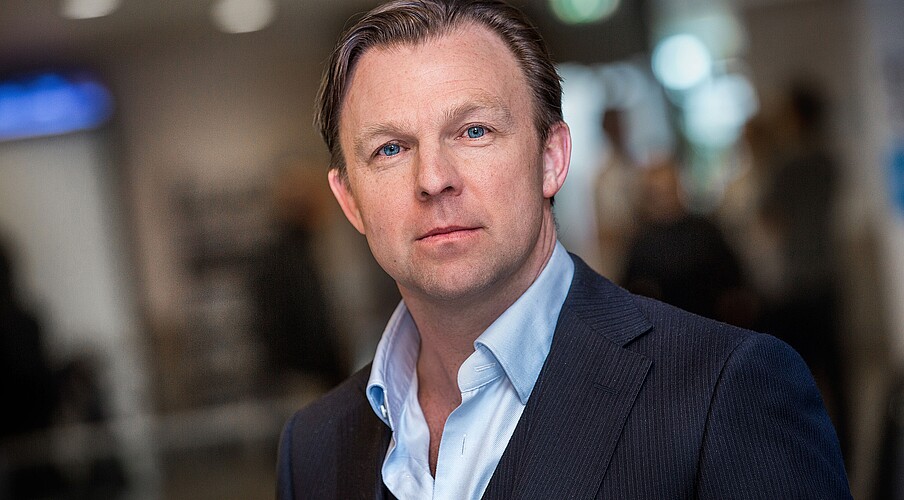
Dirk van Dierendonck has been appointed endowed Professor of Human Resource Management, a new academic chair created on 1 March 2015 at Rotterdam School of Management, Erasmus University (RSM). The chair is endowed by the Erasmus Trust Fund.
Professor Van Dierendonck will address research into human resources (HR), especially studies with a behavioural perspective. This has become an essential theoretical framework for producing new knowledge about the influence of HR practices and business strategies on employees’ behaviours and their subsequent performance, he says.
“After years emphasising the strategic importance of HR management (HRM), the most recent development is the call to put the human dimension back,” says Professor Van Dierendonck. “We know now that combining HR practices into a high-performance work system is indeed important for business success. However, most research has been done at the company level, with little attention paid to the impact of HR practices on individual workers and on the role of line management for effective HR implementation.
Professor Van Dierendonck adds: “I aim to further strengthen RSM’s reputation for high-quality research specific to HRM, with a particular focus on topics related to inclusive HR practices, leadership and leadership development, age management, employee engagement and meaningfulness at work. It will take a multilevel perspective on traditional HR topics, combining insights and methodology at micro and macro levels. The focus will mainly be on content areas that are important HR challenges now. I plan to contribute new knowledge to practice and encourage HR practices grounded in evidence-based management.”
Professor Van Dierendonck’s has published on HR related topics such as leadership, career success, selection, downsizing, measurement development, change, conflict at work, and worker well-being in terms of ‘burn-out’, job satisfaction, organisational commitment and engagement. He was recently featured in an RSM Discovery video on servant leadership .
More information
Dirk van Dierendonck obtained his master's degree in psychology from the Radboud University Nijmegen, and his PhD in social sciences from Utrecht University. Prior to joining RSM, he worked at the University of Amsterdam. His research has been published in the leading journals of management, organisational behaviour and human resource management, such as Journal of Management, Journal of Applied Psychology,Academy of Management Journal, the Journal of Organizational Behaviour, Evidence-based Human Resource Management, and British Journal of Management. Dirk van Dierendonck teaches courses on human resource management, leadership, organisational behaviour and personal leadership development at undergraduate, graduate and post-experience levels.
Rotterdam School of Management, Erasmus University (RSM) is one of Europe’s top-ranked business schools. RSM provides ground-breaking research and education furthering excellence in all aspects of management and is based in the international port city of Rotterdam – a vital nexus of business, logistics and trade. RSM’s primary focus is on developing business leaders with international careers who can become a force for positive change by carrying their innovative mindset into a sustainable future. Our first-class range of bachelor, master, MBA, PhD and executive programmes encourage them to become critical, creative, caring and collaborative thinkers and doers. www.rsm.nl
For more information on RSM or on this release, please contact Danielle Baan, Media & Public Relations Manager for RSM, on +31 10 408 2028 or by email at press@rsm.nl.