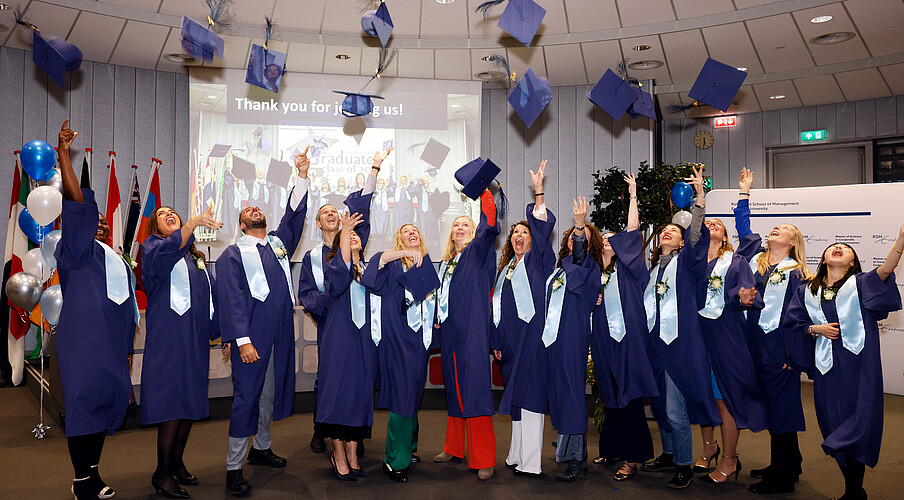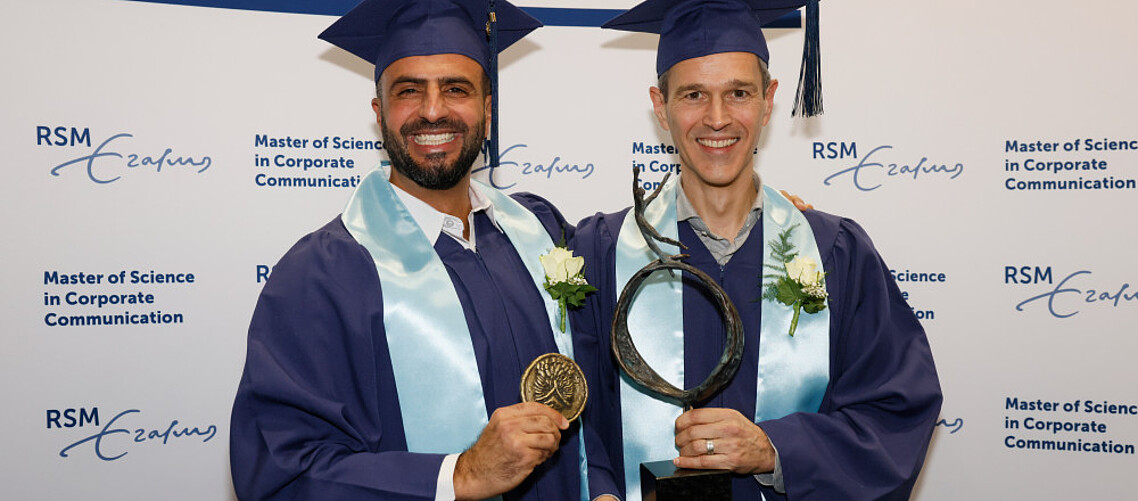
Academic Director Prof. Joep Cornelissen opened the ceremony by praising the class of 2025 as a group of exceptional professionals. He characterised the cohort by their “thirst for knowledge and learning, real self-determination and resilience”.
Prof. Cornelissen noted that the group's research was among the strongest in recent years and emphasised that they are more than just hardworking academics. “What came through this year is how strongly committed you all are, as a group, to the importance of civic, human-centred, responsible communication,” he said to the graduates, noting their focus on mutual understanding, diversity, inclusion, and collective progress.
The 15 new graduates are Rianne Biesters, Constantijn Geluk, Esther Gierveld, Caro Hamacher, Rendy Kee, Sarah Killoh, Renske Timmerman-Kragt, Christie Liu, Sherine Nehad, Ilaria Nembro, Saskia Nuijten, Justine Powell, Abdallah Touqan, Omamofe Ugboma, and Marijn de Winter. They represent eight nationalities: Dutch, Chinese, Egyptian, French, Italian, Jordanian, Nigerian, and Scottish. With an average of more than 15 years of work experience, they already hold senior positions across the corporate world, government, NGOs, and healthcare.
Communication as an architect of change
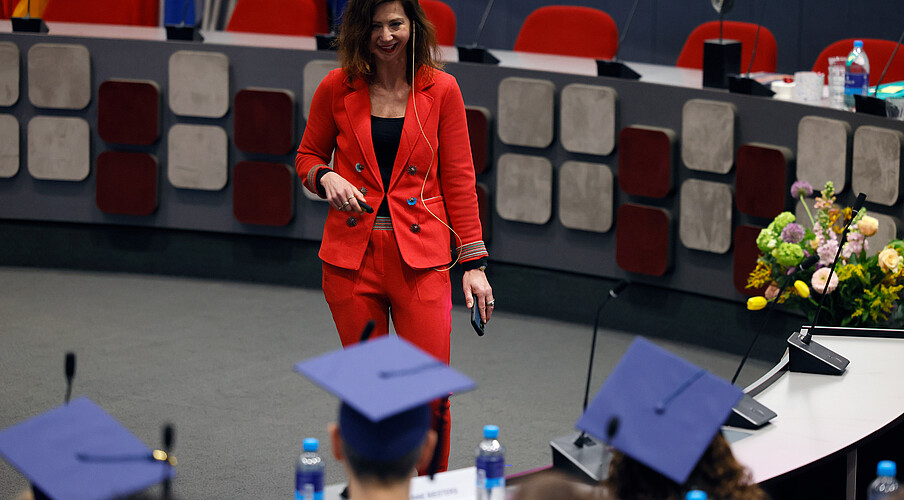
Keynote speaker Malou Kroezen, managing director of Erasmus Centre for Energy Transition and an alumna of the MCC programme, delivered a message on the transformative power of communication. She challenged the traditional view of corporate communications as a support function, stating that it is an architect of change.
Ms Kroezen explained, “Communication shapes how transitions are understood, how legitimacy is built, and how organisations move from reputation management to transition management. It frames reality and influences decision-making, and is therefore never neutral. The narratives shaped today will help determine the world future generations inherit.”
Groundbreaking research on AI and purpose
This year’s theses addressed critical strategic challenges, from embedding organisational purpose to navigating the complexities of artificial intelligence.
The Prof. Cees van Riel Award for Impact and Excellence in Corporate Communication 2025 was awarded to Constantijn Geluk for his thesis The role of internal communication in fostering organisational purpose. The jury described the work as exceeding master level expectations, earning a final grade of 9.5. “It embodies precisely the type of work this award seeks to recognise: research that not only excels academically but also demonstrates clear and inevitable impact on organisations, the corporate communication profession, and society at large.” Honorary mentions for their excellence were awarded to Marijn de Winter and Rendy Kee.
The Andreas Award for Innovation in Corporate Communication 2025 went to Abdallah Touqan for his research Leveraging AI for Proactive and Reactive Corporate Communication in Cyber Attack Scenarios. The jury commended Touqan for his creativity in exploring the emerging topic of AI in crisis communication and for providing a detailed analysis of how these technologies can be used responsibly. Ing. Dries (Andreas) van de Beek, who the award is named after, said that the thesis “is intellectually very strong and has significant implications for how both academics and practitioners can think about AI related technologies and how to incorporate these into communication workflows in a responsible and effective manner.” Honorary mentions for innovation were given to Christie Liu and Esther Gierveld, with the jury noting that they achieved nearly the same high level.
Corporate communication programmes
The Part-time Executive Master of Science in Corporate Communication offers experienced communication professionals a structured learning journey to strengthen their strategic role. Through a modular set of masterclasses, participants deepen their expertise in areas such as strategic communication, leadership and reputation while continuing their professional careers. The programme combines academic insight with practical reflection and learning alongside peers from different sectors.