A new forum for shared learning
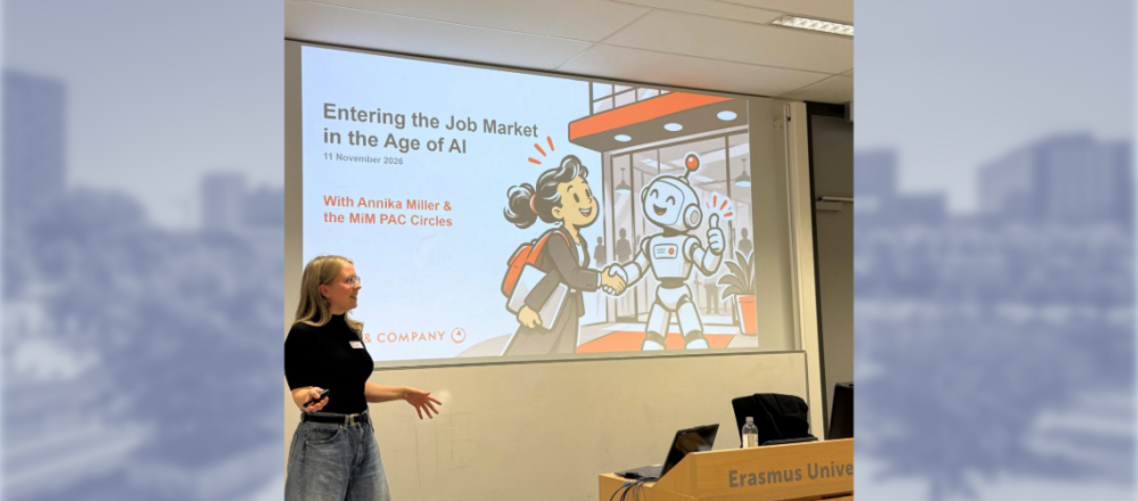
Held in early November 2026, MiM Circles launched their own self-titled workshop, a new Master in Management (MiM) programme initiative at RSM. The Circles connect students from diverse academic backgrounds, alumni and job market around the themes of arts, technology and society in relation to management.
Academic Director Dr Bas Koene opened and closed the session, which was organised by the student-led MiM Circles. MiM alumna Annika Miller (RSM MiM, 2023), now an associate consultant at Bain & Company in Amsterdam, facilitated the discussion as an open conversation rather than a lecture. Both current students and alumni provided insights during the event.
Which jobs will AI change?
Miller began with a pressing question: what happens when junior roles are among those most exposed to AI? Software development, customer service and corporate analyst roles may be particularly affected, although participants noted that European regulation and consumer preferences could shape outcomes differently.
The discussion moved beyond replacement. AI can automate repetitive tasks, amplify professional work and create new roles. From her experience in pharma, Ana Janicijevic (RSM MBA, 2021) described how AI modelling can accelerate drug discovery and support clinical-trial design. Adding from her experience in materials planning at AkzoNobel, Neha Kanchetti (RSM MiM, 2020) explained how AI agents and workflows could transform planning teams, while reinforcing the need to work with people who can connect functions, frame problems and guide implementation.
“You need to be able to tell AI what to build and how to build it,” Kanchetti said.
Human judgement remains central
Participants also considered AI’s challenges: reduced hands-on learning, constant task-switching, low-quality AI-generated work and potentially weaker face-to-face social skills. Miller, who uses AI as a tool daily, stressed the importance of understanding and checking its output rather than accepting it uncritically.
Interesting were the variations in perspectives between the Circle discussions. Where contributions of AI in the field of science and engineering were mostly welcomed, in the arts and creative Industries, the authenticity of the outcomes was much more debated.
Identified as the key graduate skills were critical thinking, problem structuring, prompting, communication and collaboration. These capabilities are increasingly important in a society where AI affects not only productivity, but how people learn, make decisions and work together.
Learning together for changing careers
Miller encouraged students to speak with alumni in their target sectors, demonstrate critical AI use on their CVs and learn actively from peers. “Really talking to each other actually helps in this learning process,” she said.
With this workshop MiM Circles kicked of its broader ambition: to provide a space for students and alumni to examine management challenges in technology, society and the arts.