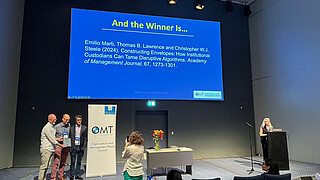
Nearly 10,000 management scholars came together during this year’s AOM conference, which took place from 31 July to 4 August in Philadelphia, Pennsylvania, USA. The conference included more than 3,000 in-person sessions. Award selections were all based on anonymous peer review and selected by the AOM Organization and Management Theory (OMT) Research Committee.
Jose Gallegos Quezada: “The recognition we received for our paper this year at AOM is particularly meaningful because, while AOM has specific award categories for PhD students and dissertation papers, this category was open to researchers at all career stages. It is therefore a special moment for our team to have our co-authored work recognised by AOM in such a competitive and inclusive category.”
About the paper
When the RSM researchers co-wrote their paper, Contesting the Future of Work: How Collective Agency Reshapes Technological Outcomes, their main question was: how does automation reshape what employers and workers can do with technology at work, and what does that mean for how change is negotiated on the terminals.
Drawing on interviews taken at the Port of Rotterdam in the Netherlands, Quezada, Prof. Simons and Dr Hewett show that automation does not simply remove tasks: it re-arranges what management and workers are each able to do with the technology, thereby affecting the extent to which labour can be dismissed, moved between jobs, or required to re-train.
The authors refer to this process as ‘affordance realignment’. The argument is that the terms of automation are settled less when a machine is installed than in the everyday governance decisions that follow, which is precisely where unions and employers can shape the outcomes of new technology introduction.
The paper draws from a multi-year qualitative study of automation at container terminals in the Port of Rotterdam. Based on 56 interviews, multiple meetings, and extensive archival material, the paper challenges the idea that workers and unions simply either accept or resist new technologies. Instead, results show how collective action and bargaining can change what automation is intended to accomplish, how it is implemented and, ultimately, the form the technology takes. This is one of the studies that constitutes Quezada’s doctoral dissertation.
About the awards won
Best Paper Proceedings, Academy of Management Annual Meeting 2026
The Academy of Management (AOM) is the main international association of management scholarship, and its annual meeting is the field’s main and largest conference. Best Papers are approximately the top ten per cent of accepted papers, designated by the programme chairs of each division. These papers are published in an abridged six-page form so that the full paper can still be submitted to a journal.
Runner-up, Best Paper award, Organization and Management Theory division
Organization and Management Theory (OMT) is the AOM division that broadly covers research on organisations, including research on organisational change, so it was a natural fit for the RSM paper. Each division gives out a wide range of prizes and honours each year, but the Best Paper award is central, given for the quality of the paper independent of whether it is from a dissertation or a specific stage in a career. With over 4,000 members, OMT represents one of the largest divisions of AOM, making this a highly competitive award.
Honourable mention, Sabina Avdagic Early Career Scholar Prize, SASE
The Society for the Advancement of Socio-Economics (SASE), is the leading international association for research at the intersection of economy, society, and politics, and is unrelated to AOM. The RSM paper was recognised with an honourable mention at the annual SASE meeting in July 2026. This prize recognises outstanding work by early-career researchers in the comparative political economy, and is awarded by its Comparative Capitalisms network in memory of Dr Sabina Avdagic, who was a political economist at the University of Sussex.