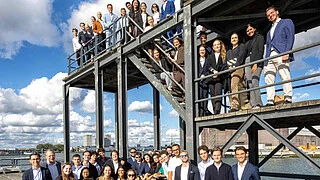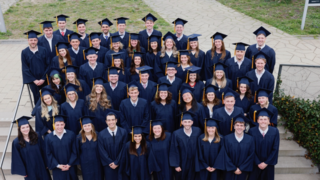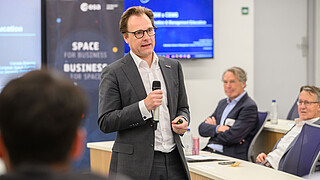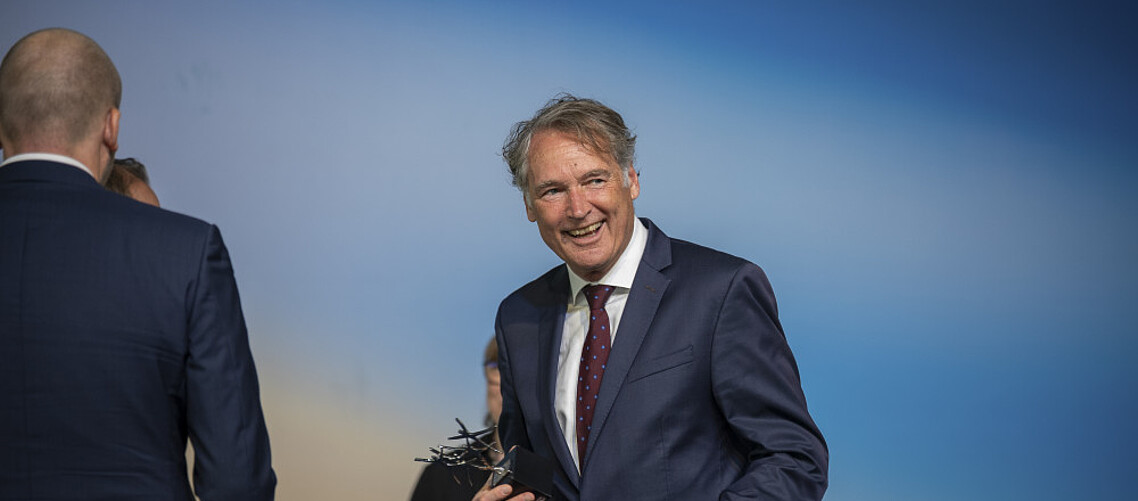
RSM’s first CEMS cohort graduated in 1991. Under Dr Olie’s watch, the character, impact, and focus of the programme itself evolved, and it has influenced the other 32 global schools that are currently part of the CEMS Alliance – hence his recognition with the Outstanding Contribution Award. “This award is to honour individuals, teams, schools, and corporate and social partners who have made a substantial and long-standing contribution to the success of the CEMS MIM,” said Marta Crabbia, Programme Manager for RSM’s MIM/CEMS, “and René is actually the ‘founding father’ of the IM/CEMS Master at RSM,” she said. “Under his leadership as Academic Director, our Master consistently ranked among the top IM programmes worldwide.”
We asked Dr Olie about the history of the MSc IM/CEMS and its role in building the reputation of RSM, and the significance of building an alliance of international business schools.
First of all, congratulations on receiving the CEMS MIM Outstanding Contribution Award! What was it like to receive this award in Rio de Janeiro as part of the CEMS/MIM graduation event in December 2025?
“During my recent visit to the CEMS graduation in Brazil, I had a significant realisation: that CEMS is a truly international platform where schools, staff and students from different parts of the world (and often in the midst of geopolitical conflicts) can meet in a friendly and cooperative atmosphere. Given the growing tensions between different states, I believe it is increasingly important to have such platforms and open channels of communication between universities. Thank you for your congratulations by the way!”
Let’s look back over your 19 years with the CEMS/MIM programme at RSM, how the programme began, and any developments or milestones shaped its identity and reputation?
“In 2006 Eric Waarts – who was then RSM Dean of Education – asked me to create a new master’s programme involving CEMS. At the time, CEMS at RSM used a ‘crown model’, meaning that students enrolled on the programme after they had finished one of the other MSc programmes. This approach was not very successful – it attracted few students, many of whom dropped out after their exchange at one of the CEMS partner schools.
Instead, in 2006 we developed an 18-month International Management MSc programme integrating both the CEMS and the RSM curricula. We were the first school within CEMS to develop this template. Many schools later followed our example. But RSM was the first… and the first years were challenging.”
How so?
“Initially we only had about 10 more student applications than available spots in the programme. But as its reputation increased, so did the number of applicants: now we usually receive more than 300 applications for the 65 available places. This enables us to be very selective and to choose the students who best fit the CEMS/RSM profile. The rising quality of the students has also enabled us to recruit excellent professors for courses, thesis coaching and project supervision.”
Over the past two decades, how have the expectations of students, and global employers, evolved with regard to the CEMS/MIM at RSM – and have those changes influenced the programme’s curriculum or teaching approach?
“Over the years, we have seen some significant trends which have been partly fuelled by the changing expectations of students, as well as those of global employers.
The first of these is the greater awareness of, and attention to diversity issues, sustainability, and responsible management generally. All of these topics now have a strong foundation in the programme. Every course addresses topics connected to sustainability and responsible management, as well as diversity.
The second development is a greater focus on competency development. Our curriculum now places much more emphasis on competencies such as leadership, collaboration and communication. At the start of the academic year, students take self-assessment tests on these competencies to identify those they wish to improve. Meetings with CEMS alumni at various points throughout the programme help students to reflect on their progress. These interactions with our alumni are also very helpful to support students in making career choices.
The third development is data literacy. This began with a request from the global CEMS student board for more ‘hard skills’ courses to be offered in CEMS. At RSM we experimented with several formats, until we decided to focus on business analytics and programming in our course portfolio. These have become a focus for other CEMS schools as well.”
CEMS places strong emphasis on international exposure and collaboration. Has that had an impact on the experience RSM offers its MIM/CEMS students?
“When I started, CEMS was essentially a European network; this changed in 2008, however, when the first non-European schools were admitted. The network now comprises 20 European and 13 non-European schools. CEMS has evolved into a truly global network, increasing its relevance as a leading alliance of management education. Now for example, graduation events such as this year’s in Brazil take place outside Europe. For RSM students, this means expanded opportunities for exchanges at non-European schools, and to meet students from outside Europe at their home school. This has definitely been a major shift, bringing the world into our classroom!
Also, several of the CEMS schools are from so-called emerging countries, such as Brazil, Colombia, and South Africa, offering students a unique opportunity to gain first-hand knowledge of doing business in less developed markets.”
Were there specific global challenges that have influenced the way the programme operates today?
“The Covid pandemic presented a major challenge to the CEMS network. International exchanges had to be discontinued or postponed, which caused significant difficulties for students who needed to fulfil their international semester and international internship requirements. Of course, we also had to start holding our work meetings, international peer reviews and so on, online. Although we managed to weather the storm, this made it clear that open borders and international travel are fundamental to keeping the network alive.
The Russian invasion of Ukraine in 2022 posed another challenge. While the local CEMS team in Russia was strongly against the invasion, maintaining an official relationship with the Russian partner, GSOM SPbU (the Graduate School of Management at St. Petersburg University) was unsustainable. The school is no longer a CEMS member.”
What areas do you think RSM’s MSc IM/CEMS programme should prioritise next – academically, structurally, or culturally – so that it can keep pace with/be a leader in global management education over the next decade?
“Although recent budget cuts are definitely challenging, I think that the IM/CEMS programme at RSM is in a good shape, and crucially it is a highly relevant programme for top MSc candidates.
Aligned with the growing emphasis in the programme that we noted above – on sustainability and responsible business, competency development and digital literacy – we have introduced new elements to the curriculum in recent years. And I think that together with AI, the effects of geopolitical tensions on companies operating internationally will increasingly be a topic of interest in global management education in general and in the RSM MSc IM/CEMS in specific."
MSc IM/CEMS: a dual degree programme
The MSc IM/CEMS is a dual qualification, an MSc in International Management from RSM plus the CEMS Master in Management Certificate from the CEMS Alliance of international business schools. The programme demands exceptional commitment and energy from students and staff alike, and only 65 students are enrolled each year.
Dr René Olie’s successor as Academic Director of the MSc International Management/CEMS programme is Dr Giuseppe Criaco, associate professor in RSM’s Department of Strategic Management and Entrepreneurship.