
“It might not be important in early stages of your career. You can get by without being able to read a financial statement. But at some point you have to provide financial justification for what you're doing, and you have to make decisions based on numbers that come from other people. If you don't know what you're looking at, and you don't know the right questions to ask, your effectiveness is diminished.”
– Professor Christopher Ittner, Wharton Business school
This programme is offered by Corporate Communication Centre BV.. For more information about the legal structure of Rotterdam School of Management, Erasmus University, visit this page.

Financial literacy has become essential for communication professionals who operate close to leadership, investors, and regulators. Finance for Communication Professionals equips you with the financial understanding needed to engage confidently in discussions on performance, risk, value creation, and stakeholder expectations.
As part of this programme, we aspire to achieve the following
As such, we will use the stakeholder model of strategic management to link stakeholders to their respective goals/targets and, in a second step, elaborate on the appropriate way to address them.



This three-day course is designed for:
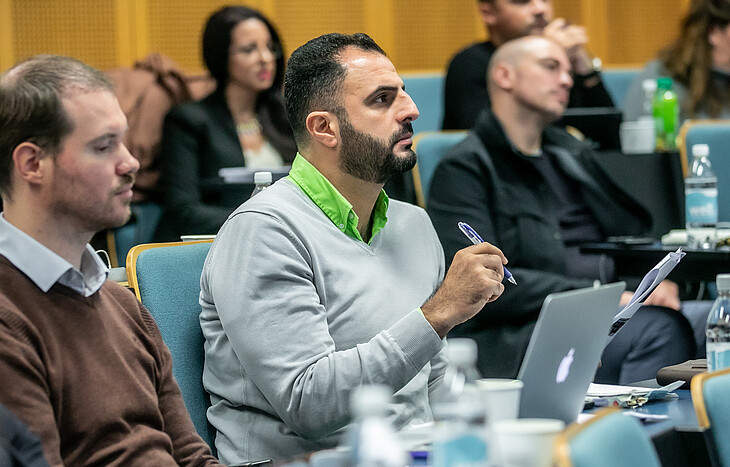
The classroom comprises of a diverse group of accomplished, driven and open-minded professionals from Europe and beyond, working in various management positions in the public and private sector, NGOs and consultancies.
Participants in this course are recommended to hold at least a bachelor degree.
Participants in this course are recommended to have 3+ years of work experience.
The lecturer made it super easy to understand the complex subjects and to make connection to my day-to-day work (which stakeholders need what information). I also liked the case method.
Isabelle Körner - Journalist
Dr Florian Madertoner combines academic expertise in finance with professional experience in banking and forensic auditing, bringing theory and real-world judgement together in the classroom. He researches capital structure theory, behavioural finance, fraud, and the history of finance. Florian teaches banking, finance and business in three modules and a minor in RSM’s international bachelor programme, and financial analysis and valuation in the MSc Finance & Investments, and also about financial markets and communication in RSM’s Executive Master in Corporate Communications. He has been awarded multiple honors for his teaching activities: the "Professor of the Year Award" consecutively for seven years, from 2016 to 2022. He also worked in banking and forensic auditing for 10 years.

18-20 May 2026

€3,750 including tuition, course material, lunches and refreshments. This fee does not include hotel accommodation.

The programme takes place in the Bayle building on the Woudestein Campus of Erasmus University Rotterdam.
Our general terms and conditions apply when you register for an open programme. Please review them to learn more about our policies for cancellation, deferral and substitution.
The participant can be substituted by someone from the same organisation on the same course without extra costs.

This course can also be taken as part of RSM's part-time Executive Master in Corporate Communication, a flexible and accredited master programme for professionals.


Programme officer

Programme & Admission Advisor