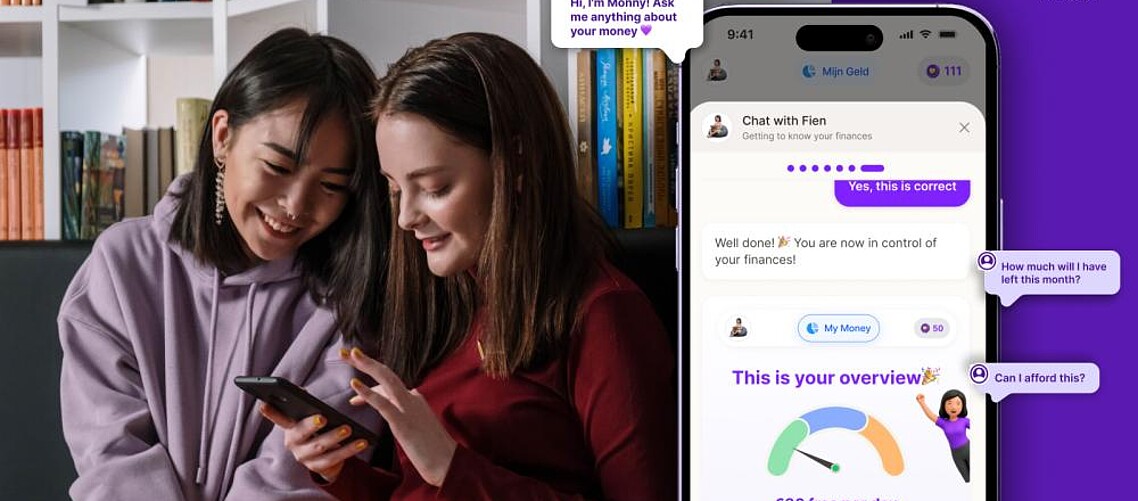
Monny is the first AI-driven financial coaching app in the Netherlands for people in financial stress, and already works with partners including Kredietbank Nederland (KBN) and Budgetmaatjes 010.
Olivier van Dijk founded Monny, a financial AI coach that can offer an intervention that is scalable, accessible without institutional involvement, available at any time, and effective for people who would never walk into a municipal office – as well as being suitable as a supplement to existing debt counselling programmes.
It’s currently in talks with several municipalities in the Netherlands too. But one of its biggest problems is getting financial advice to the people who actually need it. The team from RSM will use their expertise in behavioural sciences to find out how users perceive, trust, and interact with Monny’s AI coach. What scares people away from seeking help with handling their debts, and what are they concerned about?
Addressing the problem needs global expertise in behavioural science, AI psychology, choice architecture and experimental methodology. The co-operation between Monny and RSM exists because without Monny’s participation and the access it gives to a real product, real users, and real behavioural data, RSM’s academic research on AI financial coaching would remain theoretical.
Now, the co-operation between RSM and Monny is ready to take a further step to develop new knowledge about human interactions with AI coaching, but it needs financial partners interested in contributing to the research that will cover financial inclusion, AI innovation, behavioural science, public health and reducing social costs.
How big is the problem?
Problematic levels of debt are a huge issue for the Netherlands and are a drag on the country’s economic growth. It’s estimated that one in every eleven Dutch households – more than 700,000 – have problematic debts, and it costs the country € 8.5 billion per year because it reduces household resilience, damages public health and reduces productivity. That cost is almost three times the total that’s owed.
There is a national early detection system that flags up people who have fallen into debt. More than a million cases of overdue debts were signalled to the municipalities in 2024 but even so, the queue for getting help can be months long and problems that were relatively small can become significantly more problematic by the time they even see someone. Around 83 per cent of them were contacted and offered advice. But only a fifth of those who were invited actually talked to the municipality about their debts, and only a third who talked to the municipality actually accepted the offer of help. This represents just 8 per cent of the total number of outreaches.
Monny reaching through the bottleneck
The founder of Monny, Olivier van Dijk, explains: “The system can identify who is in trouble; the bottleneck is reaching these people and getting them to accept help.”
That looks like an enormous goal, because each municipality usually has only one full-time worker per 30,000 inhabitants. So people still struggle on their own. Research shows that some people find finances too personal to discuss, are ashamed to speak openly about their situation, or don’t know where to go. Others simply see no need for help, even when objective indicators suggest otherwise.
The current system clearly cannot structurally close this gap, but AI could potentially help democratize financial coaching and improve consumers’ financial wellbeing.
Optimising what's already been proven
The technology for the Monny app has already been tested and proven, so the deeper challenge, says Prof. Klesse, is understanding how Monny’s AI can help people with problem debts for whom human coaching is not available or acceptable. At the core of Monny is an AI coach with selectable personas, like calm and balanced, or fast and energetic, or strict and direct.
Monny users get around ten ‘cards’ a day – reflective questions that build financial awareness and give action-oriented nudges. They create a regular habit of interacting with structured conversation starters that have not been used before in financial coaching. These gentle initial interactions bridge the gap between passive engagement and active financial planning.
Rigorous understanding of users
So Monny brings two years of product development, real user data, partnerships with debt counselling organisations and a platform that can serve as a living laboratory for research. But Monny also recognises that the product can only reach its full potential when it is underpinned by a rigorous understanding of user psychology.
RSM’s research should be able to describe why Monny works, and for whom, and under what circumstances so that it can be optimised for every user. The researchers are considering several directions for their investigations, but the focus will remain on maximizing trust and engagement through Monny’s style of communication, persona, and about being transparent about the fact that it's AI. The aim is to encourage people to follow up with behaviour that starts to address their problem debts, with the ultimate objective of decreasing financial stress and increasing individual and societal well-being.
The researchers’ overarching question is ‘how can an AI financial coach reach the people that the current system cannot?’, which has already given the programme its working title: Reaching the Unreached. “This deliberate openness is a feature, not a gap. It allows the research to evolve based on early findings and funder priorities,” said project leader Prof. Anne-Kathrin Klesse.
Expert team
Prof. Klesse is Academic Director of the Psychology of AI Lab and Professor of Consumer Behavior & Technology at RSM. She will lead and co-ordinate the academic research programme within RSM’s Psychology of AI Lab, the Erasmus Centre for Data Analytics and the Department of Marketing Management at RSM, with Monny directing the technology and implementation.
Team members are:
- Assistant professor Dr Shwetha Mariadassou is co-supervisor. As Assistant Professor of Marketing, she studies human-technology interaction, communication modality, and how algorithmic labelling affects trust and compliance.
- Prof. Bram van den Bergh is an expert in the field of nudging, decision-making and self-control, and will advise on the design of behavioural interventions. His work provides the theoretical foundation for Monny's card-based system of daily financial micro-interactions.
- Associate professor Dr Romain Cadario advises on choice architecture and experimental methodology. He brings his experience of studying how a smartphone app influences behavioural change to the Monny project and financial behaviour.
- Olivier van Dijk is the founder and CEO of Monny. He has been building solutions at the intersection of financial stress and AI for more than two years. Monny works with municipalities, debt counselling organisations and social enterprises throughout the Netherlands.
Co-financing will enable progress
The plans from RSM and Monny require co-financing from two or three partners to go ahead, and are looking for them in the social debt coalition, for example large insurers and other civil society organisations and charities advocating for debt relief, poverty reduction, and fairer lending. “We expect potential partners to be organisations that can take advantage of early access to peer-reviewed, published research about how AI can support financial well-being – the kind of evidence that does not yet exist but which that will inform policy and practice for years to come,” commented Prof. Klesse.
“The primary audience is organisations in the financial wellbeing ecosystem that are aligned with Koningin Maxima's agenda, including those in and around the social debt collection movement SFGN, (the Foundation for Financial Healthy Netherlands) and the broader Dutch debt prevention landscape,” said Olivier van Dijk from Monny.
Interested organisations can contact Prof. Anne-Kathrin Klesse at the Psychology of AI Lab, Rotterdam School of Management, Erasmus University klesse@rsm.nl or Olivier van Dijk, Founder & CEO of Monny olivier@getmonny.com.