Article: Tuesday 20 October
A cyber incident at Albert Heijn brought its distribution centres to a standstill and left shelves empty within a day. It showed how dependent food retail has become on data systems and IT. Prof. Niels Agatz, Dr Harwin de Vries and Dr Robert Rooderkerk, researchers at Rotterdam School of Management, Erasmus University (RSM), share what supply chain managers in food retail can learn from the incident.
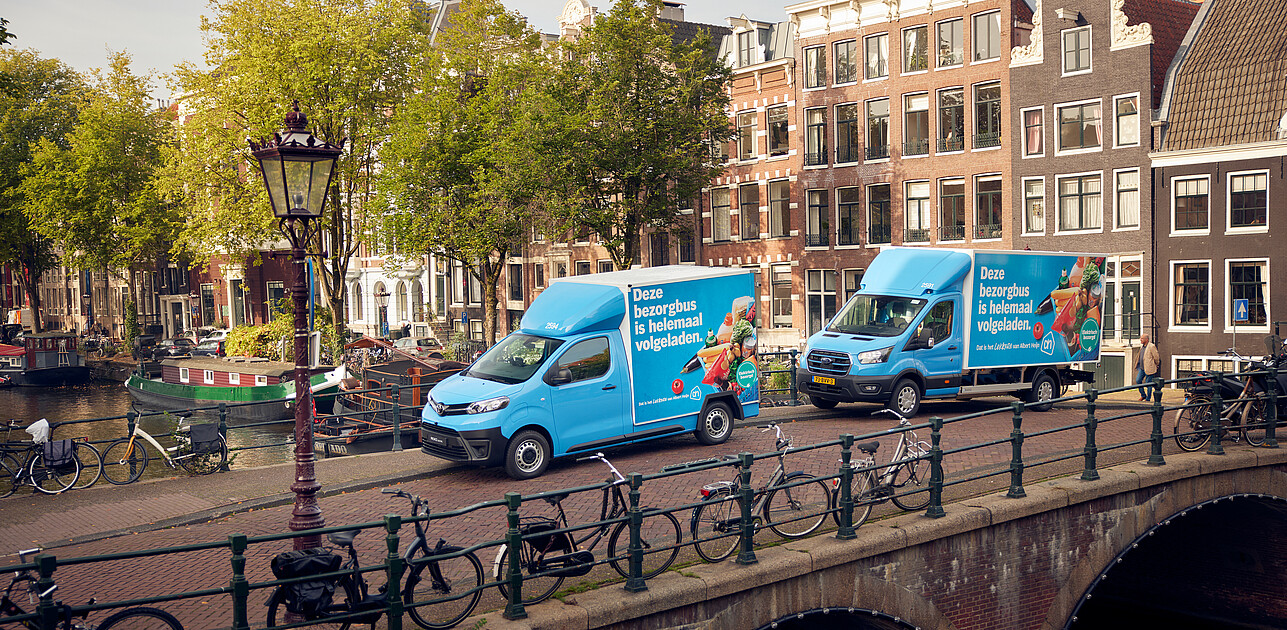
On Sunday 11 October, Albert Heijn, one of the largest supermarket chains in the Netherlands and a subsidiary of Ahold Delhaize, was hit by a cyber incident. As a precaution, the company took parts of its IT system offline. Distribution centres came to a standstill, the website and app went down, and online orders could not be delivered. Within a day, shelves began to empty, especially for fresh produce. Stores were not expected to resume regular replenishment until three days later, and a week later, home delivery still had not fully resumed. The incident shows how vulnerable food retail has become to digital disruption and how important it is to be prepared.
So, what can supply chain managers in food retail learn from this incident? We asked three researchers from RSM’s Technology and Operations Management department – Prof. Niels Agatz, professor of last-mile supply chain analytics; Dr Harwin de Vries, associate professor specialising in humanitarian logistics and supply chain resilience; and Dr Robert Rooderkerk, associate professor of operations management specialising in retail operations – the same question:
Based on your own research, what concrete lesson would you give supply chain managers in food retail to help them prepare for a disruption like the one at Albert Heijn?
Consider leaner assortments, IT systems that contain disruptions, and simple fallback procedures, such as replenishing core products based on historical sales averages.
Temporarily reduce complexity, for example by focusing on a core subset of the assortment and ensure you can ramp up the workforce quickly.
Be ready to temporarily go analogue for critical processes such as managing the warehouse, checking stock levels, placing orders and planning transport.
Robert Rooderkerk: treat resilience as a core part of retail operations, not as an extra cost.
Grocery retail runs on razor-thin margins. “When consumers spend €100 on groceries, a typical retailer may retain only around €1 in operating profit,” says Rooderkerk. “Operating efficiently is therefore not simply a competitive advantage; it is essential for survival.” The downside became clear when gaps appeared across many product categories within days, despite limited evidence of consumer stockpiling.
In an omnichannel world, retailers increasingly connect their stores and online operations, and link data from loyalty programmes, transactions and inventory systems. According to Rooderkerk, this integration is essential to creating value, but it also means that “disruptions in one part of the organisation can quickly cascade into others.”
“The central challenge is clear,” says Rooderkerk. “How can retailers become more resilient without sacrificing too much of the efficiency on which their business models depend?” He sees several avenues worth considering:
Niels Agatz: prepare contingency plans and train people to run operations under different scenarios of IT and data disruption.
Real-time inventory data allows retailers to minimise stock and reduce food waste, Agatz explains. “At the same time, the dependency on IT makes them vulnerable. The system runs on data, and without it the system is blind. Human operators also depend on this data, so they cannot do their work either.” It is like a navigation system: it helps us find our way faster, but without the maps we would struggle to get around.
Holding structurally higher stock is not the answer either: it would raise costs, threaten the affordability of food and create food waste. “The way forward is to create contingency plans and to train people better to run operations under different scenarios of disruption of the IT and data system,” says Agatz. Retailers can, for example:
Harwin de Vries: prepare alternative ways of working – including analogue ones – that you can switch to when your normal way of working breaks down.
When Albert Heijn's systems went offline, its normal way of working broke down almost overnight. For disaster relief organisations, that is a familiar situation: they work in crises, where conditions change quickly and normal procedures often stop working. De Vries has worked with more than 25 humanitarian and health organisations, studying how they make key supply chain decisions. He believes retailers can learn from how these organisations prepare.
“If there is one thing we can learn from disaster relief organisations, it is that you need to prepare different ways of working: alternatives you can switch to when your normal way of working breaks down,” says De Vries. Organisations such as Doctors Without Borders (MSF) have two to five alternative versions of the same process and can quickly switch from one to another when needed. This is called process modularity.
“Developing process modularity is a matter of preparedness: you cannot quickly build it after the crisis hits,” says De Vries. “In particular, we may need to be prepared to temporarily go analogue for critical supply chain processes such as managing the warehouse, checking stock levels, placing orders and planning transport.”
Other measures humanitarian organisations use to prepare, as De Vries described in an earlier RSM Discovery article, include:
Turning back the clock is not the answer. Instead, the researchers see the incident as a reason to take resilience more seriously, in practice and in research. Rooderkerk argues that after effectiveness, efficiency and sustainability, it is time to make resilience a fourth dimension of retail operations management. Agatz points out that resilience and dealing with disruptions are also key topics in the National Knowledge Agenda Logistics 2024–2027 of TKI Dinalog, where he is scientific director.
The incident also offers a chance to study how disruptions affect customer behaviour in the longer term. In recent work, Rooderkerk and colleagues found that failed online grocery orders delayed customers’ next purchases by 7.22%, even when retailers tried to mitigate the failure. “Which customers will return to Albert Heijn, how quickly, and which parts of their shopping baskets might they continue buying elsewhere?” asks Rooderkerk. “Analysing these patterns could provide valuable insights for optimising assortments, pricing and customer retention.”
Whether in operations or in research, the message is the same. As De Vries puts it: “As after any crisis, we should treat this as an opportunity to learn and to build back better. Never waste a good crisis.”






Science Communication and Media Officer
Rotterdam School of Management, Erasmus University (RSM) is one of Europe’s top-ranked business schools. RSM provides ground-breaking research and education furthering excellence in all aspects of management and is based in the international port city of Rotterdam – a vital nexus of business, logistics and trade. RSM’s primary focus is on developing business leaders with international careers who can become a force for positive change by carrying their innovative mindset into a sustainable future. Our first-class range of bachelor, master, MBA, PhD and executive programmes encourage them to become to become critical, creative, caring and collaborative thinkers and doers.