
Article: Wednesday 22 April
We license surgeons. We regulate engineers. We require pilots to demonstrate competence before they ever touch the controls. Yet the people making decisions that shape entire organisations, influence thousands of careers and redirect vast amounts of capital operate without shared professional standards. A growing movement in executive education is asking why — and what to do about it.
Consider what is at stake when leadership goes wrong. Failed mergers destroy shareholder value and leave employees in limbo. Ethical lapses erode public trust in institutions. Cultural breakdowns drive talent out of organisations and into competitors. Governance crises can take years to reverse. The social and economic costs of poor leadership are well documented. The absence of professionalisation is not.
That absence is now attracting serious attention.
Most high-impact roles come with a framework. Medicine has it. Law has it. Architecture, aviation and engineering have it. These frameworks typically combine three things: defined standards that describe what competence looks like, evidence-based knowledge grounded in research rather than received wisdom, and demonstrated performance under realistic conditions.
Leadership, by contrast, has long been treated differently. The field has grown into a vast industry of books, keynotes, coaching programmes and corporate offsites. Much of this content is valuable. But it is not the same as professionalisation. Inspiration is not the same as competence. Attendance is not the same as assessment. A certificate issued after a two-day workshop is not the same as demonstrated capability in conditions that actually test a leader's judgement and resilience.
The question being raised in forward-thinking executive education circles is not whether leadership development is worthwhile. It clearly is. The question is whether the field has been holding itself to a low enough standard for long enough.
Part of what makes professionalising leadership difficult is that the field has historically been shaped by fashion as much as research. Management thinking moves in cycles. Servant leadership gives way to authentic leadership, which gives way to adaptive leadership, and so on. Each wave generates its own vocabulary, its own bestsellers and its own conference circuit.
What tends to get lost in each cycle is the underlying evidence base. What does rigorous research actually tell us about the behaviours, mindsets and capabilities that distinguish effective leaders from ineffective ones? How does this vary across contexts, cultures and levels of seniority? And how do we build these capabilities in ways that go beyond self-report and good intentions?
These are the questions that evidence-based executive education is attempting to answer. Rather than anchoring programmes to whichever leadership concept is currently attracting attention, the approach grounds curriculum in accumulated research — and then designs assessment mechanisms capable of verifying whether participants have genuinely developed the capabilities in question.
At Rotterdam School of Management, Erasmus University, leadership certification has been redesigned around a progression that mirrors how leadership responsibility actually unfolds in an organisation. Development moves from leading self, through leading others, to leading teams, and finally to leading leaders and whole organisations. Each stage builds on the last, and assessment is embedded throughout rather than bolted on at the end.
Crucially, certification is not symbolic. It is not awarded for showing up, or for completing a curriculum, or for demonstrating enthusiasm. It requires demonstrated capability — evidence that a participant can exercise leadership judgement in applied, complex settings, not just describe what good leadership looks like in theory.
This shift matters because the gap between knowing about leadership and actually leading is wider than most development programmes acknowledge. Classroom learning, case studies and peer discussion all have genuine value. But they operate under conditions that are, by design, forgiving. Real leadership rarely is.
There is a counterargument worth taking seriously. Leadership is contextual in ways that surgery or civil engineering is not. The right call in one organisational culture may be the wrong call in another. Leadership is relational, adaptive and often ambiguous in ways that resist standardisation.
This is true. But it is not a decisive objection to professionalisation — it is a reason to design professional standards carefully. Medical professionals are also required to exercise contextual judgement; that has not prevented medicine from developing rigorous competency frameworks. Legal professionals operate in highly variable environments; that has not made bar examinations redundant.
The relevant question is not whether leadership is complex. It is whether that complexity justifies leaving the field without shared standards entirely. Given the scale of consequences — for employees, shareholders, communities and institutions — the case for doing nothing is harder to make than it might once have seemed.
There is also a practical argument from the other direction. Organisations that invest seriously in leadership development want to know whether that investment has worked. Assessment frameworks that go beyond participation records and satisfaction surveys give companies something they currently lack: meaningful evidence about whether their leaders are ready for the responsibilities they are being asked to carry.
Hannes Leroy, Professor in Leadership Development at Rotterdam School of Management, Erasmus University, talks about Leadership training at TEDxErasmusUniversityRotterdam.
As Academic Director of the Erasmus Center of Leadership, Hannes helps to oversee the quality of leadership development at different levels in Erasmus University (undergraduate, graduate, postgraduate, and executive education). Furthermore, as steward of the League of Leadership initiative he helps to oversee an international consortium of top business schools across the world with the mission of collectively enhancing quality standards of leadership development.

The implications extend well beyond business schools. If executive education begins to issue credentials that reflect demonstrated competence rather than programme completion, organisations will need to think differently about what those credentials mean — and what to do with leaders who cannot earn them.
This is uncomfortable territory. But it is also clarifying. A professionalised approach to leadership development creates shared language, shared standards and shared accountability. It gives talent and development professionals a framework for identifying capability gaps that goes beyond intuition. It gives leaders themselves a more honest picture of where they stand.
It also raises the bar for what executive education is expected to deliver. A business school that certifies leaders is no longer just offering development — it is making a claim about competence. That claim requires something to back it up.
The move towards professionalisation is sometimes described as a return to basics. That framing is useful, but it slightly misses the point. The basics being returned to are not nostalgic — they are the foundations that any serious profession rests on: standards, evidence and accountability.
Leadership carries systemic consequences. It always has. The question now being asked — in executive education, in boardrooms and in the conversations that determine how organisations develop their people — is whether it is time for the field to take those consequences seriously enough to build the professional infrastructure they warrant.
Pilots are not certified because flying is easy. They are certified because it is not, and because the consequences of getting it wrong fall on others. The same logic applies to leadership. The only question is how long it takes the field to act on it.


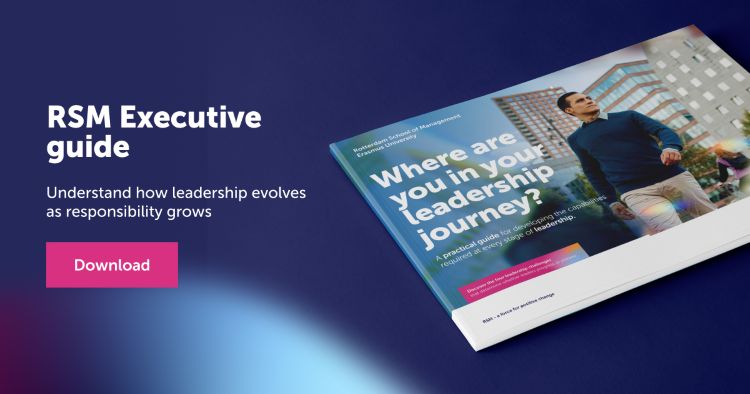
Leadership is not a linear progression, but a shift in the nature of challenges as responsibilities
grow, as outlined in Prof. Hannes Leroy's framework. At RSM we use this perspective to guide leadership development across career stages. Download the executive guide to explore what this means for your next step.


Science Communication and Media Officer
Rotterdam School of Management, Erasmus University (RSM) is one of Europe’s top-ranked business schools. RSM provides ground-breaking research and education furthering excellence in all aspects of management and is based in the international port city of Rotterdam – a vital nexus of business, logistics and trade. RSM’s primary focus is on developing business leaders with international careers who can become a force for positive change by carrying their innovative mindset into a sustainable future. Our first-class range of bachelor, master, MBA, PhD and executive programmes encourage them to become to become critical, creative, caring and collaborative thinkers and doers.