Article: Thursday 19 Feburari
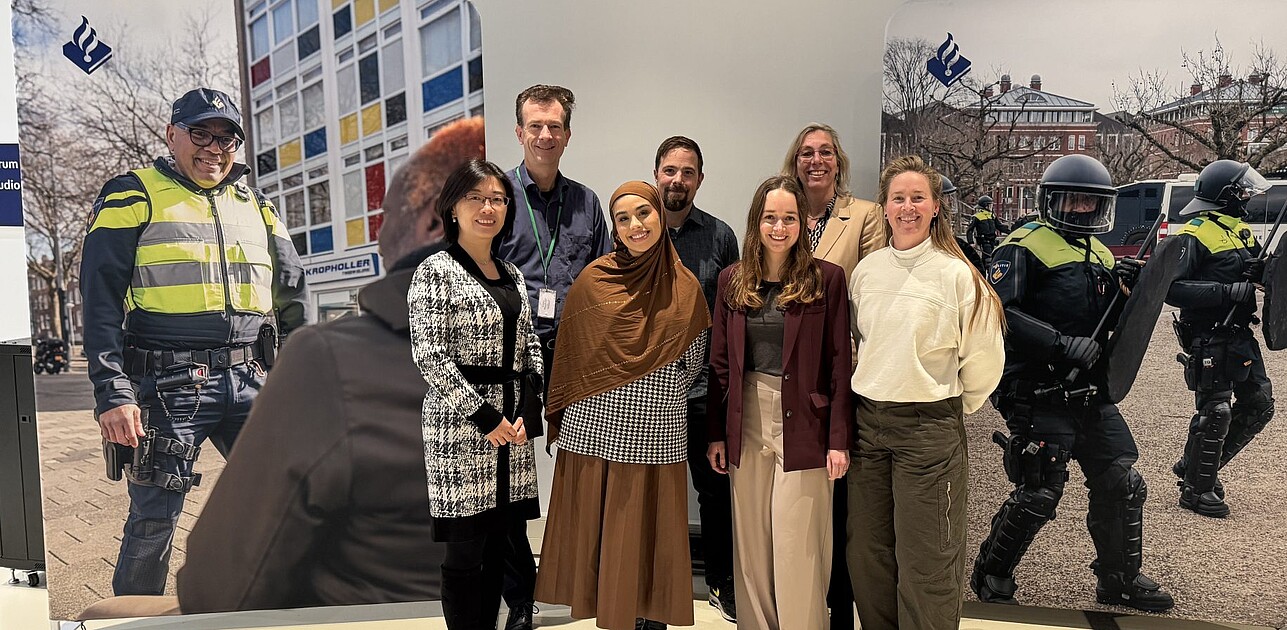
At an age when most recent graduates are navigating their first corporate jobs, 23-year-old Rania Bamhaou spends three days a week embedded within the Dutch police, researching how virtual reality training can help officers make better decisions under extreme pressure. Her unusually early start as a PhD candidate puts her at the forefront of a question with real consequences: can immersive technology make society safer? Rania is a PhD candidate in the Department of Technology and Operations Management at Rotterdam School of Management, Erasmus University (RSM).
Let’s set the scene; a police officer puts on a VR headset and virtually steps into what seems like an everyday call about noise complaints from neighbours. But as he assesses the situation, the scene begins to shift. The tension rises, people in the environment around him react, and within minutes the incident escalates into a serious crime. These are exactly the kinds of scenarios at the heart of Bamhaoudi’s PhD research. She examines how police training using Extended Reality – an umbrella term that includes virtual reality (VR) and augmented reality (AR) – can be designed more effectively. XR is already used within the police to practice stressful situations. “It is very interactive,” she says. “You go through all the steps and have to make decisions on the spot.”
What is still largely missing is solid scientific knowledge about what actually makes this method of training effective. “We know relatively little about what exactly happens when officers learn in VR. How does behaviour change over time? Which forms of reflection work and which do not? That is what I want to understand better.” Her ambition goes beyond improving training modules alone. “I hope this research can help make society a bit safer. Better trained officers ultimately mean safer situations across the Netherlands.”
Bamhaoudi began her PhD at the age of 23, an unusually young age to start academic research. During her master’s programme in business analytics and management at RSM, she started questioning what her next step should be. “I am really not the type who would be happy in a corporate job on the Zuidas she says, referring to Amsterdam’s financial district. “I would miss creativity and social meaning.” Teaching and learning were a common thread through her studies. She gave private tutoring, taught Dutch language classes to international students, and discovered that research suited her. “I never understood why people disliked writing their thesis so much. I actually really enjoyed it.”
That turned out to be an important sign. She moved into roles as research assistants working with professors, and the idea of an academic career began to take shape. When she narrowly missed out on another PhD position, that was a disappointment. Shortly afterwards, this opportunity emerged. “They said it would be a shame if you did not try again. And then I thought: you will never know if you do not try.”
Her collaboration with the police makes this a distinctive PhD project. It is one of the few doctoral studies that started with a concrete assignment from an external organisation. “The police is an incredibly large and complex organisation. To do good research, you really need to understand how it works.”
Her approach is deliberately broad, and she travels around the country working with behavioural data from XR simulations, setting up experiments comparing different training formats, and speaking directly with police officers. “I am perhaps looking forward to those conversations the most. That is the only way to truly understand how they learn and what they experience.”
What makes her profile distinctive is her position between two worlds. With a background in international business administration and experience with technology, she sees herself as a translator. “I understand the developers, but also the organisational side. Being that link between technology and practice is something I find very valuable.”
Bamhaoudi is acutely aware of the responsibility that comes with police work. Her first encounter with a VR training session left a strong impression. “You see how much is happening at once. It is not a simple step by step procedure. You have to constantly switch, stay alert, and still project a sense of calm. People turn to you in moments of crisis. Then you need to know what you are doing.”
That is why she believes in the power of XR, if it is used properly. “Not everything needs to be done in VR. I want to understand when it really adds value and when it does not.” Her goal is clear. “If, after five years, I can improve and speed up the learning process for this group, I will be very satisfied.”






Science Communication and Media Officer
Rotterdam School of Management, Erasmus University (RSM) is one of Europe’s top-ranked business schools. RSM provides ground-breaking research and education furthering excellence in all aspects of management and is based in the international port city of Rotterdam – a vital nexus of business, logistics and trade. RSM’s primary focus is on developing business leaders with international careers who can become a force for positive change by carrying their innovative mindset into a sustainable future. Our first-class range of bachelor, master, MBA, PhD and executive programmes encourage them to become to become critical, creative, caring and collaborative thinkers and doers.