Article: Wednesday 14 October
Researchers examined how GenAI reconfigures the creative process.
Activities that used to happen across different stages, people, and spaces get compressed into a single back-and-forth between the creative worker and the GenAI tool. There’s also a temptation for creative workers to assume work is finished before ideas have fully developed – the researchers called this ‘early aesthetic closure’.
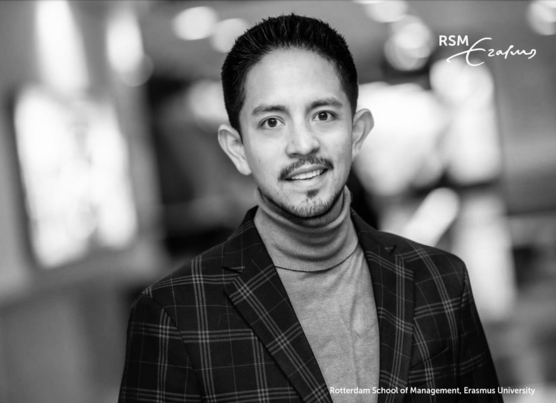
These findings have significant consequences for how creative work is organised, say Dr Jana Retkowsky Assistant Professor at Rotterdam School of Management, Erasmus University (RSM) and co-researchers from Vrije Universiteit Amsterdam Prof. Marleen Huysman, director of the KIN Center for Digital Innovation; and Associate Professor Dr Ella Hafermalz.
The findings are described in their article Harnessing a "Spirited Technology": How Working with Generative AI Collapses the Creative Process published in the academic journal Academy of Management Discoveries.
GenAI tools are rapidly transforming creative industries, yet most research has focused on whether AI makes people more or less creative in lab experiments. Dr Retkowsky said: “We wanted to understand what actually happens when real creative professionals use these tools in their everyday work. More specifically, how it changes not just what they produce, but how they work, who they work with, and how entire projects unfold.”
The researchers gathered a year’s worth of working output from a creative team at RTL Nederland BV, a major Dutch media company, to analyse what’s changed.
The research demonstrated how AI is reshaping professional creative work by fundamentally reorganising how the creative processes unfold, who participates in them, and what skills matter in a development process. It highlights that skilled human work remains essential but risks becoming invisible. This has implications for creative workers’ fair compensation, career development, and the general sustainability of creative professions.
The researchers concluded that GenAI has already reshaped the organisation of creative work, and this calls for more research on AI’s role in creativity. Dr Retkowsky commented: “Skilled creatives can learn to ride with AI’s unpredictability, using its surprises as creative fuel. Their skill prevents that because any concept can look like a Hollywood poster in minutes; the ideas that win approval are the ones that visualise well, not necessarily the ones that are most original or strategically sound. That’s a blind spot that organisations need to watch out for.”
“A key risk is what we term as ‘early aesthetic closure’,” said Dr Retkowsky. “We found that GenAI collapses the creative process – activities that used to happen across different stages, people, and spaces get compressed into a single back-and-forth between one creative and the GenAI tool, with significant consequences for how creative work is organised.”
As GenAI reorganizes who participates in creative processes and what skills matter, organizations, policymakers, and educators need to ensure that the human expertise driving quality is recognized, fairly compensated, and sustained.
The researchers summarised their three main discoveries:
Organisations using GenAI in creative work should recognise that the real skill now is aesthetic judgement. What separates effective use from mediocre results is the ability to evaluate, react to, and guide the outputs of tasks done using AI. Dr Retkowsky says: “Companies should invest in developing this skill among their creative teams rather than assuming anyone can get good results from AI.”
This is particularly important for recruitment and hiring decisions. “Leaders should be aware that GenAI can make it look like the technology did the work, when in reality it was skilled human judgment that drove the quality. There’s a risk that assuming AI can do the work undervalues human creative talent. It could lead to poor decisions in hiring and resourcing.”
The researchers gave guidelines for using AI in creative projects.
Teams should establish clear protocols for presenting AI-generated concepts to clients. For presentations, the creative workers should emphasise that the AI images are sketches, not final deliverables. Actively separating the idea evaluation from the way it’s visually presented by AI is a step that product developers can instigate in their innovation workshops or start-up pitches.
Creative workers should include what the final product will show – Dr Retkowsky suggested that companies should consider using a standard disclaimer statement or make sure to explain clearly what is and is not possible when showing their concepts to clients for the first time.
Production workflows need updating, advises Dr Retkowsky. When AI-generated images serve as the reference point, then photographers, set designers, and post-production teams need new coordination practices that apply to their face guide mark-ups and lighting direction documents. “Organisations should formalise these practices rather than leaving them to individuals doing them on their own initiative,” she said.
Beyond the advertising industry, this research carries an important warning for anyone using GenAI to develop product concepts or business ideas.
When AI can make any idea look stunning in seconds, there’s a real risk that teams and decision-makers start selecting ideas based on how beautiful the visualisation looks rather than the strength of the underlying idea.
Dr Retkowsky suggests that evaluating concepts in low-fidelity form first, before anyone uses GenAI tools for visualisation, would let the strength of the idea get a fair viewing. “Otherwise, organisations risk building their strategies around the most photogenic ideas rather than the most promising ones, which could narrow innovation and favour incremental, easy-to-picture concepts over truly novel ones that are harder to render."
“This is the dark side of early aesthetic closure: it biases decision-making toward what looks best, not what is best.”


Read the full article in Academy of Management Discoveries: Harnessing a "Spirited Technology": How Working with Generative AI Collapses the Creative Process

Science Communication and Media Officer
Rotterdam School of Management, Erasmus University (RSM) is one of Europe’s top-ranked business schools. RSM provides ground-breaking research and education furthering excellence in all aspects of management and is based in the international port city of Rotterdam – a vital nexus of business, logistics and trade. RSM’s primary focus is on developing business leaders with international careers who can become a force for positive change by carrying their innovative mindset into a sustainable future. Our first-class range of bachelor, master, MBA, PhD and executive programmes encourage them to become to become critical, creative, caring and collaborative thinkers and doers.